

By 2026, cybersecurity will have evolved from reactive defense to proactive anticipation. Attackers leverage increasingly complex techniques, making legacy security tools struggle to keep pace. Intelligent platforms are predicting threats, learning from patterns, and assisting human teams in stopping attacks before they unfold.
Key Takeaways
- Preemptive Defense: AI now detects abnormal patterns and hidden threats early, even before known malware signatures emerge.
- Faster Response: AI and automation reduce the data breach lifecycle by an average of 10 days.
- Hybrid Operations: Tools handle scaling and routine responses, while human teams retain central authority for complex and ethical decisions.
Why AI in Cybersecurity Matters Now
To combat rapid, complex attacks, modern security operations rely on intelligent platforms to:
- Analyze massive volumes of logs in seconds to find anomalies humans might miss.
- Automate routine responses so teams can focus on high-level strategy and prevention.
- Secure hybrid and remote workforces using intelligent access control.
Proven Impact and Data
Real-world deployments demonstrate the effectiveness of adaptive learning and machine speed:
- Darktrace Autonomous Response: Successfully isolated an affected device to prevent ransomware damage at a multinational technology manufacturer, and stopped a Log4j vulnerability exploit at a global financial services firm in real time.
- Financial Savings: According to IBM Security’s Cost of a Data Breach reports, the global average cost of a breach reached US$4.88 million. However, organizations using AI and automation across security workflows significantly reduced their overall costs and minimized business disruption.
The Limits of Intelligent Security
Despite advanced tools, human expertise remains central to effective cyber defense. AI cannot fully grasp insider intent, cultural context, or highly nuanced threat scenarios.
- Investigation: Humans are required to validate automated alerts and investigate complex incidents.
- Governance: Compliance and data-privacy oversight depend on human policies and accountability.
The strongest security organizations maintain hybrid teams where tools handle early detection and routine tasks, while trained analysts focus on strategy and complex investigations.
Your Strategic Checklist for 2026
To stay ahead of modern threats, leaders should:
- Evaluate and adopt transparent, explainable intelligent security platforms.
- Build hybrid teams by training staff to collaborate with AI rather than viewing it as a replacement.
- Maintain strong oversight to govern compliance and data privacy.
Because in 2026, the best defense is an intelligent one. Stay ahead with AI Opportune.
You May Also Like

How Aembit Helped a $300B Investment Firm Secure AI Agent Access
As AI agents connect to sensitive company systems, businesses need clear access controls and accountability. Explore how an investment firm secured Claude assistants for 500+ users and learn…
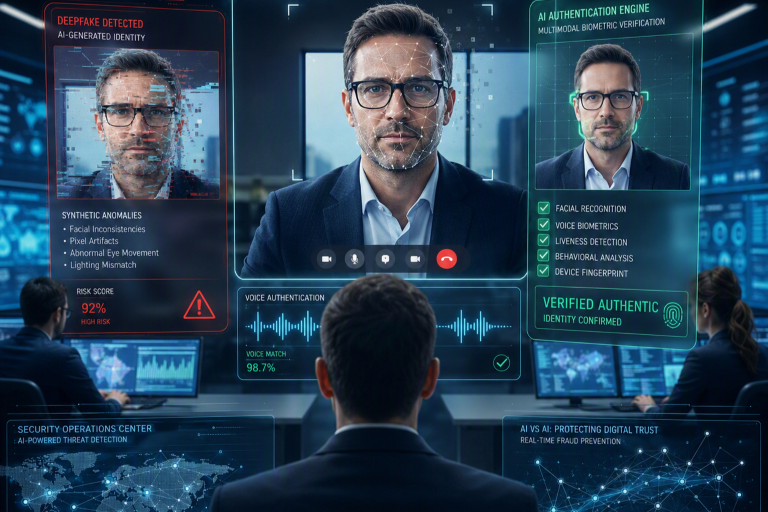
AI vs AI: Enterprise Deepfake Detection with Artificial Intelligence
When synthetic media first made headlines, most people laughed at distorted viral videos of celebrities. Today, nobody is laughing. Cybercriminals are using generative AI to clone voices and…
3 SOC Challenges You Must Solve In 2026: An AI Playbook for Startups
As of 2026, SOC teams face intense pressure from alert overload, AI‑assisted attacks, and an urgent need to prove business value. The global cost of cybercrime is projected…
⚡Building AI-Powered Fraud Detection for Fintech: The 2025 Blueprint
In 2026, AI is transforming personalized medicine from a research concept into clinical reality. From AI-designed drugs and precision diagnostics to smart nutrition apps and faster cancer detection,…