

When synthetic media first made headlines, most people laughed at distorted viral videos of celebrities. Today, nobody is laughing. Cybercriminals are using generative AI to clone voices and spin up fake video feeds in real time, making human identity the scariest new threat vector in tech. In this piece, we break down how modern enterprises are fighting back using AI-driven deepfake detection, exploring the signals these systems look for, the software vendors leading the charge, real-world deployment workflows, and a practical roadmap for security teams trying to keep trust intact.
The New Cybersecurity Battlefield
We used to tell employees to look out for weird email addresses or broken grammar to spot a scam. Those simple rules don’t work anymore. Generative AI tools have made phishing indicators obsolete overnight, allowing bad actors to build hyper-realistic impersonations that fly right past standard awareness training.
Take the high-profile incident in early 2024 involving the engineering giant Arup. An employee joined a video call where every single colleague on screen was actually an AI-generated deepfake clone of company leadership. The result? A devastating $25 million payout to fraudsters. The network perimeter wasn’t breached, and no passwords were stolen, but human trust completely fell apart.
Business Email Compromise (BEC) has jumped from sketchy messages to live voice and video manipulation. Attackers need only a few seconds of public audio, from a podcast, a conference presentation, or an earnings call, to clone an executive’s voice and pressure finance teams into rushing wire transfers. Others are applying for remote engineering jobs with synthetic faces, passing live video interviews just to get inside internal codebases. Identity, not the firewall, is the new frontline.
Why Traditional Controls Fail
Standard tools like Multi-Factor Authentication (MFA), VPNs, and complex passwords do a great job securing access points, but they are utterly blind to whether the person on the other end of a webcam is a real human being.
When an attacker enters a legitimate SMS code while running a synthetic video mask over Zoom, traditional systems mark the session as 100% safe. This gap has pushed companies toward Enterprise Authenticity, a continuous security posture where digital interactions are constantly vetted for biological reality before high-stakes actions go through.
How AI Detects Deepfakes
Fighting synthetic AI requires machine learning models trained on millions of authentic and manipulated media files. Rather than relying on what looks or sounds right to human eyes and ears, enterprise detection platforms analyze microscopic digital artifacts that generative models inevitably leave behind:
- Visual Anomaly Detection: Systems track unnatural micro-expressions, frame jitter, blurring around facial boundaries, pixel-level artifacts, and lighting mismatches between a person’s eyes and their surroundings.
- Acoustic & Voice Analysis: Models measure spectral biometrics, irregular cadence, unnatural pitch distributions, missing natural breath pauses, and subtle frequency glitches unique to text-to-speech engines.
- Behavioral Biometrics: Detection engines look at micro-movements during live sessions, such as head rotation depth, natural eye blinking, typing speed, and cursor interaction patterns.
- Multimodal Signal Fusion: Advanced platforms check visual data, audio streams, and network metadata simultaneously. A face might look perfect, but if the audio frequency latency doesn’t line up with standard network packets, the system sounds the alarm.
Leading Solutions & Enterprise Use Cases
Instead of building detection tools from scratch, security teams are plugging established verification platforms directly into their daily operations.
| Solution Provider | Primary Focus | Practical Industry Application |
| Reality Defender | Multimodal detection | Scanning live executive meetings & flag high-risk documents |
| Pindrop | Voice biometrics & liveness | Catching voice-cloned social engineering in banking call centers |
| Truepic | Camera provenance | Securing mobile media capture for field claims at firms like State Farm |
| Hive | Media verification APIs | Filtering user-generated content and platform media in real time |
Practical AI Implementation Workflow
Adding deepfake detection into your infrastructure shouldn’t mean grinding daily operations to a halt. The goal is to build an invisible verification pipeline behind your most sensitive communication channels.
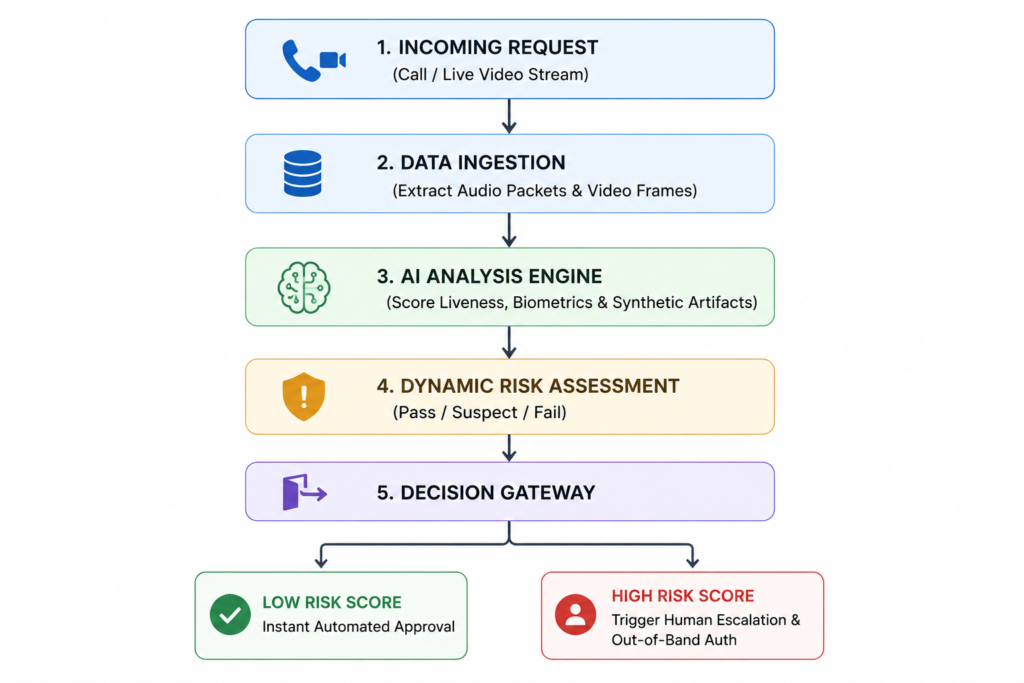
Business Drivers
Companies aren’t buying these tools just to play with cool AI. They’re doing it to stop multi-million-dollar fraud losses, lower the manual workload on compliance teams, and avoid becoming the next embarrassing headline in the press.
A Real-World Banking Example
Imagine how a regional commercial bank handles a high-value wire request over $100,000:
- Trigger: A caller phones in asking to move funds urgently to a new vendor account.
- Ingestion: The phone system routes the live audio through a background detection API.
- Analysis: Within 200 milliseconds, the engine scans the voice against baseline acoustic profiles and checks for synthetic generation artifacts.
- Action: The system flags synthetic acoustic patterns. Instead of processing the transfer, the call automatically transfers to a senior fraud investigator who triggers an out-of-band physical security token request.
A Realistic Rollout Roadmap
- Map High-Risk Workflows: Figure out every business process that relies solely on a face or a voice authorization, like wire transfers, executive access grants, or password resets.
- Plug in Gateways: Integrate detection APIs directly into existing comms tools like Zoom, Microsoft Teams, or your contact center platform.
- Define Clear Escalations: Don’t let AI make the final firing or blocking call on its own. Set clear risk score thresholds that send suspicious cases straight to trained human reviewers.
- Train Your Teams: Run regular drills so employees know exactly what voice-cloning attacks look like and never feel bad about double-checking an executive’s identity through a secondary channel.
Opportunity Lens
For founders, product managers, and security leaders, the massive shift here is toward Zero Trust Identity Verification. We are moving away from static answers to security questions and toward continuous, real-time proof of human reality.
The companies that adopt automated authenticity checks early will build a huge competitive advantage. In a world where anything digital can be synthesized, being able to guarantee trust at machine speed is a massive superpower.
The Future of Synthetic Media Defense
Securing an enterprise isn’t just about patching software bugs anymore, it’s about verifying what is real. As generative models become faster and more convincing, the organizations that stay ahead will be the ones treating human authenticity as something that must be continuously proven, not just assumed.
You May Also Like

3 SOC Challenges You Must Solve In 2026: An AI Playbook for Startups
As of 2026, SOC teams face intense pressure from alert overload, AI‑assisted attacks, and an urgent need to prove business value. The global cost of cybercrime is projected…
⚡Building AI-Powered Fraud Detection for Fintech: The 2025 Blueprint
In 2026, AI is transforming personalized medicine from a research concept into clinical reality. From AI-designed drugs and precision diagnostics to smart nutrition apps and faster cancer detection,…

🛡️Adaptive Defense: Why AI is the Cybersecurity Standard in 2026
In 2026, AI is transforming cybersecurity from reactive defense to proactive, predictive protection. With cyberattacks accelerating and evolving, AI-powered tools are detecting anomalies, stopping threats in real time,…