

From predictive maintenance to AI-driven supply chains, manufacturers today do more than make products. They build systems that learn, adapt, and support better decisions.
At AI Opportune, we break down how industrial teams use AI to reduce downtime, control costs, and improve safety, while keeping human judgment firmly in control.
Why AI is the Backbone of Modern Manufacturing
Intelligence now sits at the core of operations, powering resilient plants, flexible supply chains, and data-driven production planning.
For both high-volume factories and lean operations, AI helps industrial teams:
- Anticipate failures before they halt production.
- Optimize logistics in real time.
- Maintain quality without overloading teams.
Where AI Delivers the Biggest Gains
- Predictive Maintenance: Eliminating Downtime
Instead of reacting to breakdowns, manufacturers rely on predictive maintenance. Platforms like Augury and Falkonry use vibrations, acoustic, and sensor data to detect early signs of equipment failure. The ROI: Data validated by Capgemini shows predictive maintenance programs reduce unplanned downtime by up to 50% and cut maintenance costs by 10% to 40%.
- Supply Chain Optimization: Agile Operations
AI-driven planning reshapes volatile supply chains. Platforms from ToolsGroup, Kinaxis, and o9 Solutions help manufacturers continuously balance demand, inventory, and production capacity.
Research by Boston Consulting Group (BCG) confirms these tools achieve up to a 15% improvement in service levels alongside a 20% to 30% reduction in total inventory carry costs.
How to Implement AI in Manufacturing
Why Build Connected AI Systems?
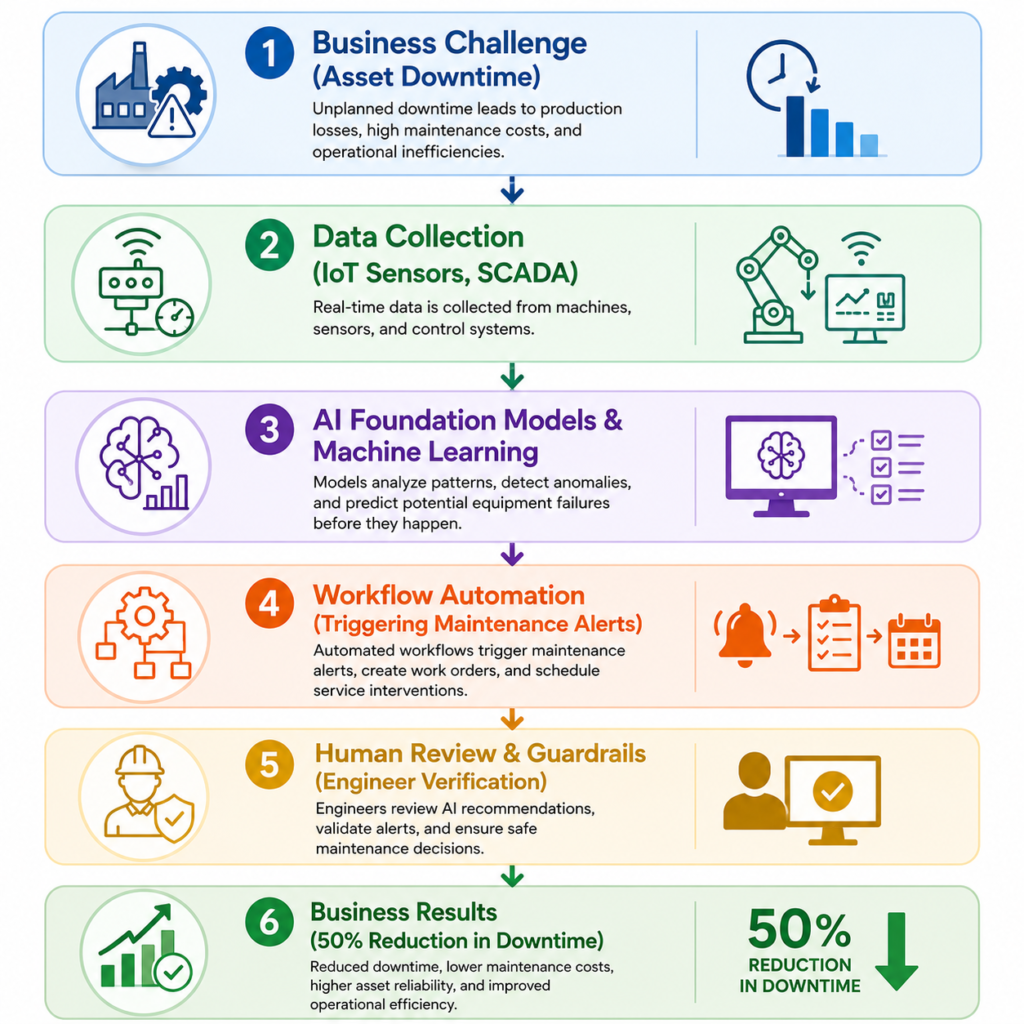
Industrial leaders face rising operational costs and unpredictable supply chains. Adopting AI directly addresses these challenges by eliminating repetitive work and boosting overall equipment effectiveness (OEE). Instead of isolated software tools, successful teams build an integrated, automated workflow:
Real-World Implementation Scenario
Imagine a mid-sized automotive components startup experiencing unexpected machinery failures. To solve this, they install acoustic and vibration sensors on their primary press.
These sensors stream real-time data to an edge-computing AI agent. When the model detects an anomalous frequency, it references historical logs, automatically drafts a maintenance ticket, and alerts the floor supervisor. The engineer fixes the component during a scheduled shift change, preventing an expensive emergency shutdown.
A Practical Rollout Strategy
Implementing industrial AI takes careful planning. A realistic approach involves a step-by-step rollout:
- Identify the Use Case: Select a single, critical asset with a history of frequent, costly downtime.
- Ensure Data Quality: Clean your historical records and verify sensor APIs stream clean, structured data.
- Run a Pilot Program: Deploy predictive maintenance on that single asset for 60 to 90 days to benchmark accuracy.
- Train the Team: Upskill floor technicians to interpret AI insights and use the feedback loop to improve the model.
- Establish Governance: Set clear parameters regarding which automated actions require human sign-off.
- Scale Gradually: Connect the verified system to broader supply chain planning tools once the initial ROI is proven.
The Opportunity Lens
The greatest opportunity for the startup founders lies in the transition from reactive data collection to proactive automation. Early adopters who connect factory-floor data directly to supply chain decisions will build an unassailable operational advantage. Start by identifying your single biggest source of operational friction today, instrument it with basic sensors, and experiment with predictive models.
The Bottom Line
The competitive divide is not between humans and machines, but between legacy factories and those mastering a hybrid operating model: AI generates the predictive insights; humans drive the strategy.
What is the biggest operational bottleneck in your facility today, and how could predictive insights help your team solve it?
Stay tuned to AI Opportune for our upcoming deep dives into the top predictive maintenance and supply chain platforms set to dominate 2026.
You May Also Like

📸 From Prototype to Product: How AI is Rewriting Hardware Innovation
Most AI hype is locked in on chatbots and copilots. But the real transformation is happening inside R&D labs and on factory floors. By shrinking physical iteration loops…

Hyundai’s 2028 Roadmap: Scaling Physical AI at the Georgia Metaplant
Will humanoid robots finally replace manual labor in automotive manufacturing? By 2028, Hyundai Motor Group (HMG) will move beyond the “viral video” stage of robotics, deploying a fleet…
Inside TCL’s Factories: How AI Quietly Became Manufacturing Infrastructure
How TCL Makes AI Work in Real Manufacturing: Practical Lessons from Vertical Integration Who This Is For This piece is for startup founders, product leaders, and operators building…