

Shoppers in 2026 expect relevance, speed, and convenience at the same time. They want brands to remember them, anticipate their needs, and still feel human. Quietly, AI has become the system making that possible.
This is not about flashy tech or experimental pilots anymore. The most successful retailers today use AI as everyday infrastructure. It helps them forecast demand, personalize shopping journeys, and reduce waste, all while keeping brand identity and trust intact.
In this edition of AI Opportune, we explore how AI is reshaping retail operations and customer experience in real, measurable ways. From smarter inventory decisions to personalized storefronts and virtual try-ons, here is how leading retailers are using AI to sell better and serve faster in 2026.
The Retail Shift Is Real and It Is Powered by AI
Retail success in 2026 is no longer defined by store size or discount depth. It is defined by how well a business uses data.
AI now sits at the center of pricing, merchandising, marketing, and customer support. Whether it is a global marketplace or a growing DTC brand, retailers rely on AI systems to respond to demand changes in real time, optimize assortments by location, and support customers across channels.
According to ongoing industry research from firms like McKinsey & Company, retailers that embed AI into core operations consistently outperform peers on inventory efficiency and customer satisfaction, not because they automate everything, but because they make better decisions faster.
Three Core Retail Problems AI Solves
1. Too Much Stock, Too Little Insight
Demand forecasting has historically relied on spreadsheets and intuition. AI-driven forecasting models now analyze historical sales, local demand signals, weather patterns, and online behavior to improve accuracy. This helps retailers reduce overstock, avoid stockouts, and protect margins.
2. One-Size-Fits-None Marketing
Customers expect personalization across email, apps, and storefronts. AI enables retailers to tailor recommendations, promotions, and content to individual shoppers based on real behavior, not static segments.
3. Customer Service Overload
AI-powered chat and voice assistants handle routine queries instantly. This reduces wait times and allows human agents to focus on complex or emotionally sensitive issues where empathy matters most.
How Retailers Are Using AI in Practice
Smarter Inventory and Fewer Returns
Retail-focused AI platforms such as Vue.ai and Nextail help brands analyze browsing behavior, sell-through rates, and regional preferences. Retailers use these insights to:
- Predict seasonal demand more accurately
- Localize assortments by store or region
- Reduce deadstock and unnecessary markdowns
Fashion and apparel brands, in particular, report measurable reductions in returns by aligning inventory more closely with customer intent.
Hyper-Personalized Shopping Experiences
Tools like Shopify Magic and Dynamic Yield are now embedded into eCommerce workflows. They allow brands to:
- Curate personalized homepages and product feeds
- Test pricing, bundles, and layouts dynamically
- Adapt recommendations based on real-time behavior
Retailers using these systems focus less on blanket campaigns and more on relevance at the moment of decision.
Visual Search, AI Stylists, and AR Try-Ons
Computer vision is now a practical shopping tool. Platforms like Syte and Lykdat enable shoppers to upload photos and find visually similar products. At the same time, AR try-on technology from companies such as Snap AR and Perfect Corp allows customers to preview products digitally.
The result is higher confidence at checkout, longer engagement, and fewer abandoned carts.
Does AI Actually Deliver Results in Retail?
AI in retail is no longer theoretical. Large consulting and research firms consistently report tangible impact:
- Boston Consulting Group has documented revenue uplift from AI-driven personalization across retail and consumer goods, especially when personalization is applied across multiple touchpoints.
- Capgemini Research Institute reports steady gains in customer satisfaction and operational efficiency among retailers that scale AI beyond pilots.
- NVIDIA’s annual retail industry surveys show significant reductions in operational costs and improved demand forecasting among AI-mature organizations.
What matters most is not the model size or novelty, but integration into everyday decision-making.
What AI Still Cannot Do
AI supports retail, but it does not replace judgment or values.
- Merchandisers still define brand identity and aesthetic direction.
- Human service teams remain essential for complex problem-solving and emotional support.
- Trust, transparency, and ethical sourcing must be led by people, not algorithms.
- AI outputs require governance to prevent bias and protect customer privacy.
Retailers that succeed treat AI as an assistant, not an authority.
What Comes Next: AI and Retail Teams Working Together
The next phase of retail innovation is collaborative. In 2026, we see:
- Store associates using AI-assisted tools to provide real-time product advice
- Design teams leveraging AI trend analysis to inform, not dictate, new collections
- Loyalty teams identifying at-risk customers earlier and re-engaging them thoughtfully
- Sustainability teams using AI to reduce waste and improve inventory planning
This is augmentation, not replacement.
Your Next Step: Don’t Fall Behind the Checkout Curve
The retailers winning in 2026 are not spending more. They are spending smarter, with AI embedded into how teams work.
Follow AI Opportune for practical tools, real-world use cases, and clear strategies that help retailers move from experimentation to execution. Whether you manage three stores or three thousand SKUs, AI can help you scale with precision and a human-first mindset.
If you want AI insights that actually move products, stay with AI Opportune. We turn tomorrow’s intelligence into today’s retail advantage.
You May Also Like
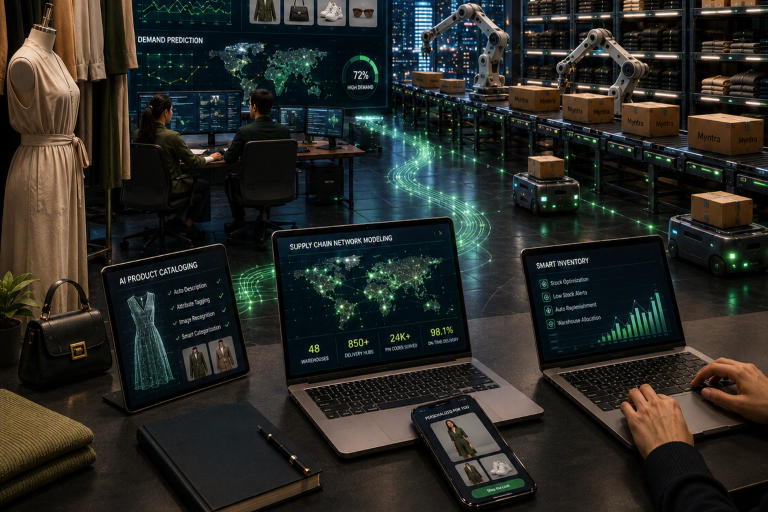
How Myntra Transformed AI From a Chatbot Into Core Business Operations
Myntra, the fashion e-commerce giant backed by Walmart through Flipkart, handles more than 50 million active users. Juggling thousands of global brands alongside lightning-fast trend cycles naturally creates…

How Shopify’s Vantage Discovery Acquisition Redefines AI Semantic Search for Retailers in 2026
The acquisition of Vantage Discovery by Shopify marks a definitive shift from “keyword matching” to intent-based commerce. As generative AI becomes the primary interface for shopping, the traditional…
Microsoft Agentic AI in Retail: A 2026 Guide to Autonomous Intent Execution
How can retail leaders use Microsoft's agentic AI to automate inventory management, eliminate checkout friction, and transform physical stores? Microsoft's 2026 agentic AI strategy shifts retail from assistance…