

AI Transformation in Insurance
Insurance acquisition is shifting from static web forms to conversational interfaces embedded inside daily AI tools. Aviva‘s deployment of a home and life insurance quoting app inside ChatGPT signals how conversational interfaces, agentic commerce, and secure API handoffs are redefining digital product distribution and top-of-funnel customer intake.
What Is Changing in Insurance Distribution?
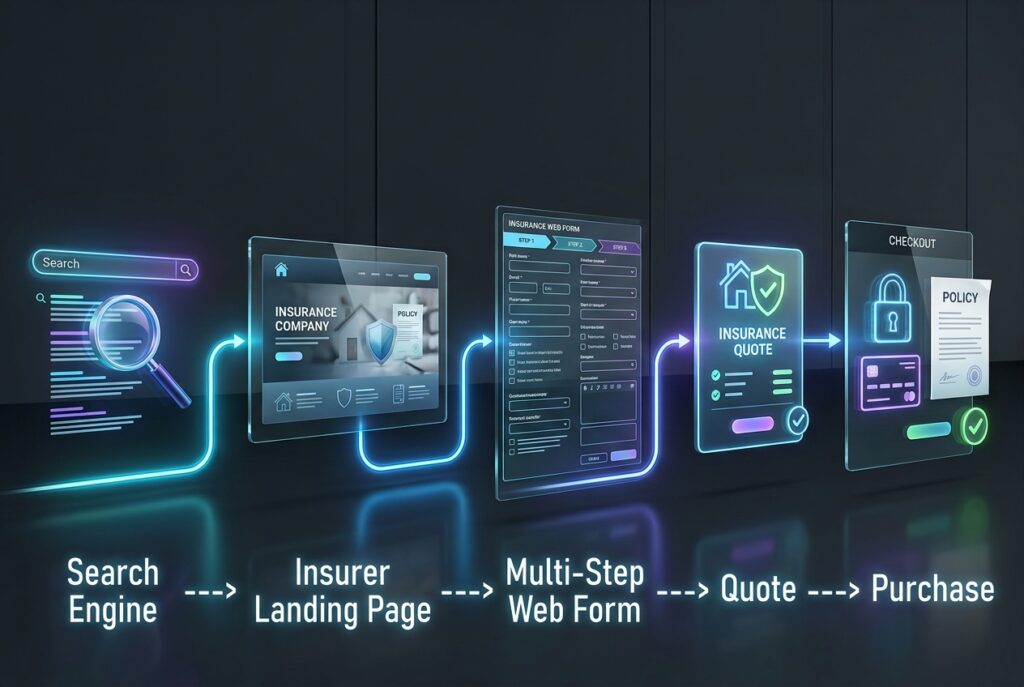
For decades, buying insurance followed a predictable online routine: visit an insurer’s website, fill out a multi-page form, compare coverage options, receive a quote, and make a payment.
In 2026, that journey is beginning to shift.
Aviva, one of the UK’s largest insurers, launched an app inside ChatGPT that allows customers to begin their insurance journey directly within a chat interface. Instead of starting on a traditional web portal, users can ask questions and request quotes conversationally.
This move signals how AI is evolving from a back-office utility or customer support tool into an emerging distribution channel for financial products.
What Is Aviva Actually Doing Inside ChatGPT?
Aviva announced its ChatGPT insurance app in March 2026, initially offering quotes for Signature Home Insurance. In June 2026, it expanded the experience to include an initial life-insurance quote.
Traditional Distribution:
Aviva’s 2026 Distribution:
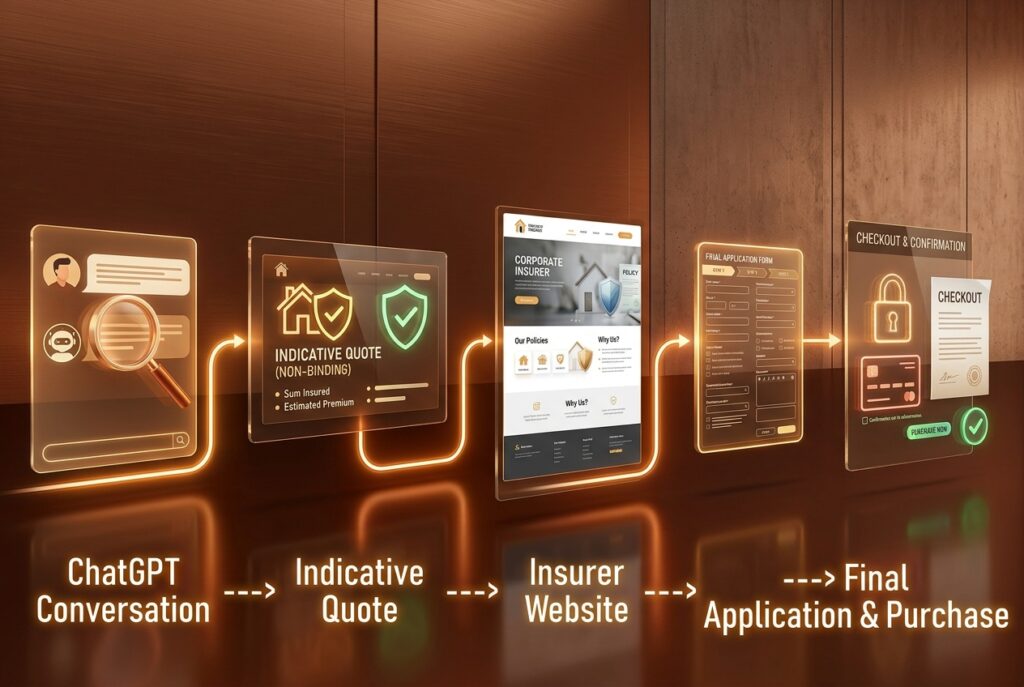
Aviva is using ChatGPT as an additional entry point into its insurance journey, allowing customers to obtain quotes conversationally before completing the application and purchase process through Aviva’s existing digital infrastructure.
- AI-Assisted Quoting: Customers obtain an initial quote through ChatGPT by answering conversational prompts.
- Controlled Handoff: Customers do not complete the purchase inside ChatGPT. To select additional covers and limits, review policy documents, choose payment options and complete the purchase, customers are handed off to Aviva’s website.
This setup represents AI-assisted distribution rather than fully autonomous insurance purchasing. The conversational interface manages top-of-funnel intake, while the regulated insurer retains control over underwriting and policy execution.
What Does the Early Data Tell Us?
During testimony to the UK Parliament Financial Services Regulation Committee on July 22, 2026, Jason Storah, CEO of UK & Ireland General Insurance at Aviva, shared early performance observations.
Aviva told the UK Parliament that around 60% of customers using its conventional online journey complete the quoting process, while more than 90% of customers using its ChatGPT experience reached the quote stage.
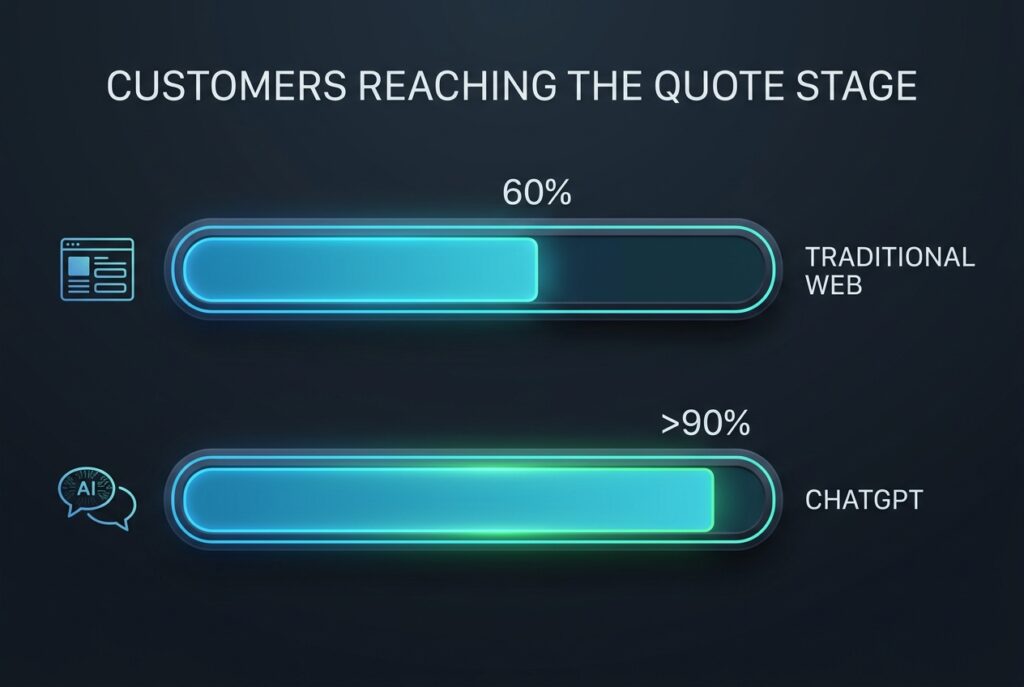
Understanding this metric accurately requires keeping a few key points in mind:
- Quoting vs. Purchasing: Reaching the quote stage does not mean 90% of those users purchased a policy.
- Friction Reduction: The higher completion rate suggests that conversational intake may lower cognitive friction compared to rigid web forms.
- Early Data: This represents an early company-reported observation rather than proof that conversational AI universally improves insurance conversion.
Naked Insurance Shows Where This Could Go
Aviva isn’t the only insurer testing conversational channels. South African digital insurer Naked Insurance launched a ChatGPT experience connected directly to its live underwriting and rating systems.
Naked Insurance’s app allows drivers to complete a conversational intake flow and receive a final, bindable car insurance quote inside the ChatGPT environment.
Model Comparison:
Aviva:
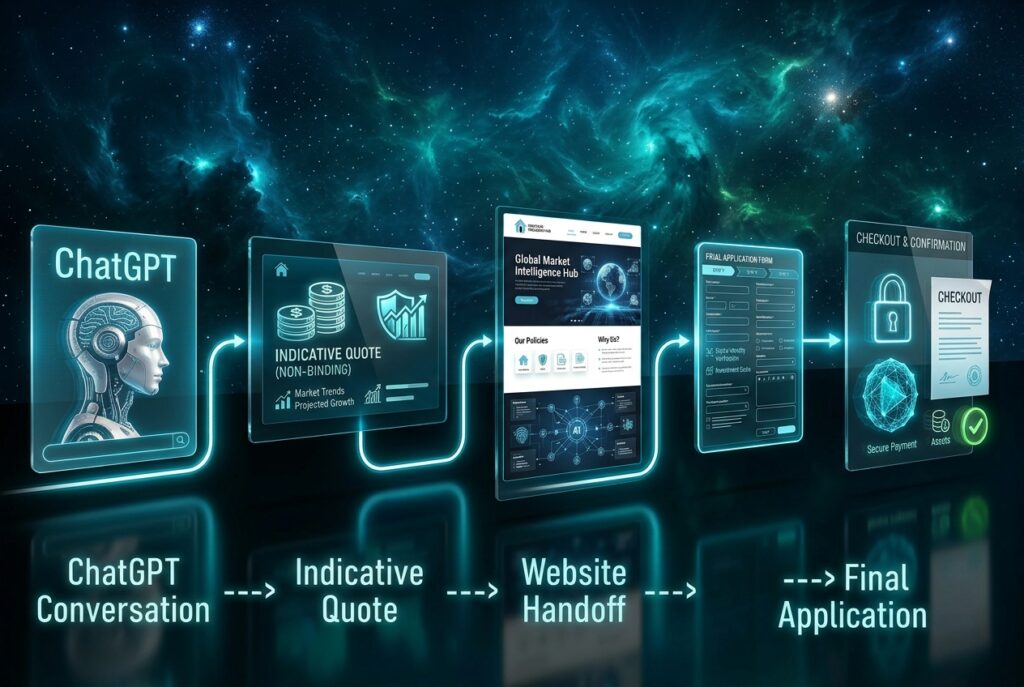
Naked Insurance:
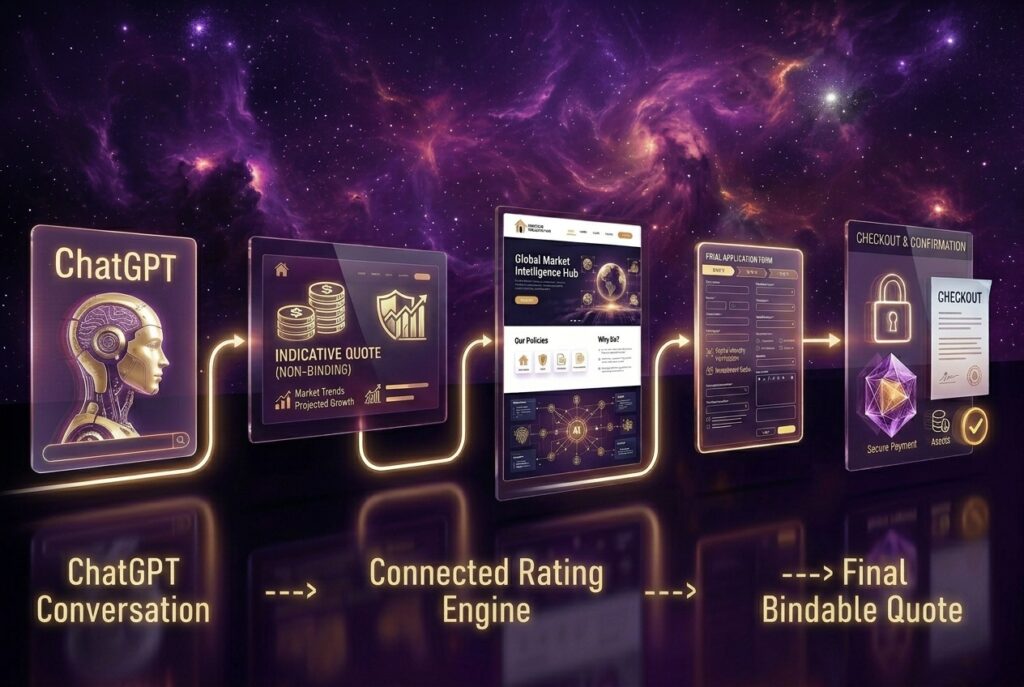
Comparing these approaches illustrates how different insurers deploy AI: Aviva uses a hybrid handoff model, while Naked Insurance connects ChatGPT more directly to its live underwriting and rating systems to generate a final car-insurance quote.
Is This the Beginning of Agentic Insurance?
In a June 2026 analysis, Deloitte noted that more than 100 insurance apps were queued to go live on the ChatGPT app store, while companies including Tuio, Insurify, Aviva, Experian, and MoneySuperMarket had already launched experiences.
Deloitte describes this shift as part of agentic commerce in financial services.
Agentic Commerce: A model in which AI helps people discover, compare, evaluate, and potentially transact for products or services through natural language interaction.
But there is an important reality check. Deloitte argues that many of these early launches are still more about establishing a presence inside AI-driven customer journeys than fundamentally changing distribution economics. The strategic value today may be as much about learning how customers behave in conversational environments as it is about immediate sales.
The market reality across 2026 shows clear implementation stages:
- Currently Real: AI-assisted discovery, conversational quoting, conversational comparison, AI-connected insurance systems, and customer handoffs to insurer websites.
- Emerging: AI agents comparing products on behalf of customers, AI-assisted recommendations, and deeper API-based transactions.
- Not Mainstream: Fully autonomous insurance purchasing, AI independently binding complex policies, and AI making unsupervised regulated decisions.
Aviva’s Broader AI Operational Use Cases
Separately from its ChatGPT distribution experiment, Aviva is deploying AI across internal operational pipelines. In its 2026 financial updates, Aviva reported on several parallel AI implementations:
- Medical Underwriting: Aviva reported that its generative AI medical underwriting tool has halved the time required to review individual medical cases by summarizing medical reports.
- Claims Handling: Voice-enabled AI agents manage initial claims intake and status tracking.
- Quality Assurance: Autonomous software agents assist with compliance monitoring in wealth management operations.
For founders, the broader lesson is that AI’s value may compound when it is applied across multiple points in the customer and operational lifecycle, from discovery and quoting to underwriting and claims.
What Can Insurance Startups Learn?
A Practical Architecture
Aviva has not publicly disclosed every technical component of its ChatGPT integration. For a startup or product team building a similar conversational insurance experience, however, a practical technical framework connects discovery to backend execution in eight clear steps:
Customer Discovery
- Conversational Intake
- Structured Data
- Validation
- Secure Backend/API Connection
- Quote Generation
- Compliance/Human Review
- Secure Handoff
- Measurement
This production architecture uses large language models to parse natural conversation into structured data schemas, which are then validated before invoking backend rating engines, compliance rules, and secure handoff mechanisms.
What This Could Look Like for a Startup
Imagine a hypothetical insurtech startup named CoverCraft that offers commercial property insurance for small businesses.
Instead of directing ad traffic exclusively to a multi-page web form, CoverCraft builds a custom conversational app for third-party chat platforms. The assistant asks the business owner four natural questions about their company, maps the responses into a validated data payload, queries the rating engine via REST APIs, presents two coverage options in the chat, and provides a secure link to complete electronic signatures on CoverCraft’s owned site.
A Simple Rollout Strategy
Deploying conversational intake in regulated environments requires a disciplined approach:
- Start Narrow: Target simple, standardized insurance products before attempting complex, multi-variable enterprise policies.
- Identify High-Friction Points: Determine where potential customers currently drop off in your conversion funnel.
- Convert Text to Validated Data: Ensure natural language inputs map strictly to verified backend parameters before executing API calls.
- Maintain Control Over Binding: Keep final legal disclaimers, identity verification, and payment processing on secure, owned platforms.
- Audit System Responses: Review conversational transcripts regularly to monitor response accuracy and prevent misrepresentation.
- Track Conversion Funnels: Monitor quote completion, abandonment, accuracy, escalation, customer satisfaction, and compliance to refine conversational flows.
What Happens Next?
Conversational quoting is an intermediate step. As AI models gain reliability, distribution may evolve toward integrated agentic commerce, where conversational systems help users discover, evaluate, compare, and connect with financial products within single interfaces.
The competitive question is no longer only whether an insurer can sell online. It may increasingly be whether AI assistants can discover, understand, recommend, and connect customers to that insurer’s products.
Opportunity Lens
AI may become more than another customer-service channel. It could become a new distribution layer between customers and businesses.
Instead of asking where you can add a chatbot, ask which part of your customer journey could be completed through conversation instead of another form.
What part of your customer onboarding flow could be completed through a conversation instead of another web form?
You May Also Like

The STP Pivot: Why 2026 is the Year of the Autonomous Insurance Claim
For decades, "Insurance Automation" was a polite term for digital filing cabinets. In 2026, the industry has crossed a critical threshold where speed is no longer the goal,…

How Patra AI is Automating the Commercial Package Policies in 2026: A Guide for Insurance Teams Scaling to 85% Workflow Automation
How AI is finally automating complex commercial policies, modernizing workflows, and reinventing insurance operations for faster, smarter decisions In 2026, Patra AI’s breakthrough in insurance automation leapfrogged the…

AI in Insurance 2026: Rebuilding Trust Through Faster Claims and Smarter Fraud Detection
From near-instant claims approvals to fraud signals spotted before losses spiral, AI is steadily transforming insurance works in 2026. This shift is quiet. You will not find it…