

From near-instant claims approvals to fraud signals spotted before losses spiral, AI is steadily transforming insurance works in 2026.
This shift is quiet. You will not find it in morning newspaper headlines. Yet it is already changing how insurers price risk, process claims, and rebuild trust when it matters most. At AI Opportune, we focus on where AI actually earns its place. Insurance is one of those places.
The Quiet Revolution Inside Insurance
Insurance has always been about trust. Customers trust insurers to show up when life goes wrong. Insurers trust data to price risk fairly.
For decades, that balance was strained by slow claims, manual reviews, and reactive fraud detection. AI is now closing that gap.
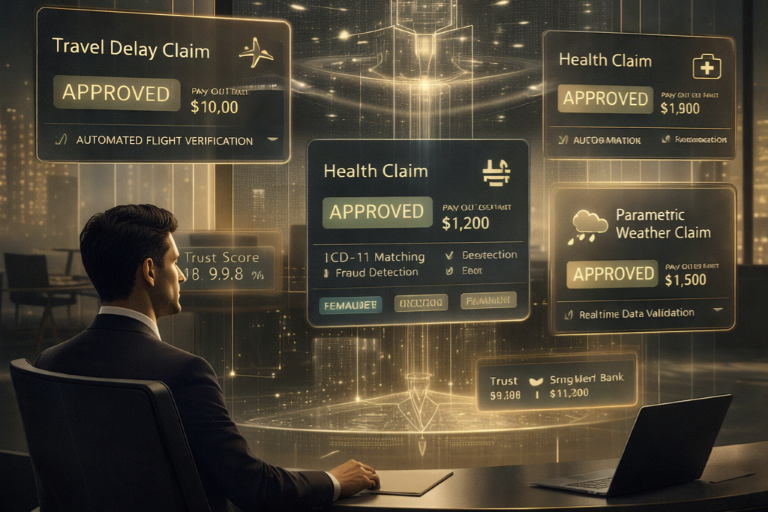
Across underwriting, claims, and fraud teams, AI systems work in the background, analyzing patterns humans simply cannot process at scale. The goal is not automation for its own sake. It is speed where speed matters, accuracy where errors are costly, and time for people where empathy is essential.
This is not about replacing adjusters or agents. It is about giving them better tools.
Smarter Risk and Faster Response in 2026
Insurers are investing in AI because traditional models struggle with modern risk. Climate volatility, digital fraud rings, and rising customer expectations demand real-time intelligence.
Here is where AI is making a measurable difference.
Climate-aware underwriting
Reinsurers and primary carriers now use AI models that ingest satellite imagery, geospatial data, and historical loss records to assess climate exposure more dynamically. Firms like Swiss Re integrate geospatial analytics to improve flood, wildfire, and storm risk assessment.
Predictive retention and servicing
Machine learning models flag policies at risk of lapse or churn weeks in advance. This gives agents time to intervene with pricing adjustments, coverage reviews, or proactive outreach. It is one of the simplest ways AI improves lifetime customer value without touching claims.
Fraud detection at scale
AI-driven fraud systems analyze claims patterns across millions of records, spotting anomalies humans would miss. According to Capgemini’s World Insurance Report, insurers using advanced analytics see meaningful reductions in claims leakage and fraud losses.
Real AI in Action Today
This is not experimental. It is already embedded in production systems.
Swiss Re uses machine learning and geospatial intelligence to enhance underwriting precision and catastrophe modeling across global portfolios.
Allianz has expanded AI-based claims triage and routing, particularly in motor insurance, reducing settlement times for straightforward claims and freeing adjusters for complex cases.
Lemonade continues to run one of the most transparent AI-driven claims systems in the industry. Its AI assistant, Jim, handles simple claims end to end, while human teams step in for edge cases or sensitive situations. Lemonade regularly publishes how its AI models are governed and audited.
Industry-wide, adoption is accelerating. Deloitte reports that most large insurers now use AI across claims, underwriting, or fraud detection in some form, with claims automation leading the way.
Why Speed Alone Is Not the Point
The biggest benefit of AI in insurance is not automation. It is trust.
When AI handles routine claims efficiently, adjusters gain time for complex, emotionally charged cases.
When agents spend less time on paperwork, they spend more time advising clients.
When customers receive fast, consistent decisions, confidence improves.
There are moments no model should own alone. Explaining a denied medical claim. Supporting a family after a flood. Navigating ambiguity when the data is incomplete.
AI creates space for humans to do that work better.
The Winning Model in 2026: AI Plus Human Judgment
The insurers pulling ahead in 2026 are not chasing full automation. They are building hybrid teams.
AI handles scale, pattern recognition, and speed.
People handle judgment, nuance, and care.
Leading insurers are investing in training adjusters and agents to work alongside AI systems. Teams learn how to review AI recommendations, challenge edge cases, and communicate decisions clearly to customers.
Technology alone does not build trust. People using it well do.
The Real Risk Is Standing Still
Customer expectations are rising. Digital-first experiences are no longer optional. Fraud is becoming more organized. Climate risk is becoming harder to model with legacy tools.
AI is not a future advantage in insurance. It is a present requirement.
The good news is that insurers do not need to rebuild everything at once. Claims triage, fraud detection, and underwriting analytics are practical starting points with proven ROI.
At AI Opportune, we break these shifts down clearly, without hype, and with real examples from the field.
Stay with AI Opportune.
The future of insurance is being rebuilt quietly, and it has only just begun.
You May Also Like

Aviva Puts Insurance Inside ChatGPT: How AI Is Changing Insurance Distribution in 2026
AI Transformation in Insurance Insurance acquisition is shifting from static web forms to conversational interfaces embedded inside daily AI tools. Aviva's deployment of a home and life insurance…
The STP Pivot: Why 2026 is the Year of the Autonomous Insurance Claim
For decades, "Insurance Automation" was a polite term for digital filing cabinets. In 2026, the industry has crossed a critical threshold where speed is no longer the goal,…

How Patra AI is Automating the Commercial Package Policies in 2026: A Guide for Insurance Teams Scaling to 85% Workflow Automation
How AI is finally automating complex commercial policies, modernizing workflows, and reinventing insurance operations for faster, smarter decisions In 2026, Patra AI’s breakthrough in insurance automation leapfrogged the…