

Anticipating the “Teacher-First” AI Revolution: Trend, Tools, and ROI for the Year Ahead
As we near the end of 2025, the global education sector is transitioning from “AI experimentation” to intelligent infrastructure. For founders, school leaders, and EdTech teams, the goal for 2026 is no longer just digitization; it is hyper-personalization at scale.
In this edition of AI Opportune, we forecast how the classroom of 2026 will bridge the achievement gap by putting “Superpowers” in the hands of educators.
🌍 Why 2026 Will Be the Year of Adaptive Learning
The “one-size-fits-all” model is reaching its breaking point. As we head into 2026, Intelligent Augmentation (IA) is the primary solution for rising classroom sizes and diversifying student needs.
🎯Top Trend to Watch in 2026:
- AEO-Optimized Learning: Students are moving away from static search; in 2026, they will use voice-activated “AI Study Buddies” to ask, “Why is this formula used here? “, requiring schools to adopt conversational AI tools.
- Predictive Intervention: Using HolonIQ’s 2026 Data Models, schools will soon identify students at risk of falling behind 3 weeks before a failing grade occurs.
- The “Admin-Zero” Goal: By mid-2026, AI is projected to automate up to 40% of administrative tasks, finally allowing teachers to focus on 1-on-1 mentorship.
🎯High-Impact Tools Scaling for 2026
These platforms are currently setting the gold standard for Mastery-Based Progression in the coming year:
- Adaptive Pathways: CENTURY Tech uses neuroscience to create “pathways of least resistance.” Early 2025 data suggests these paths increase standard mastery by 1.5x.
- Multimodal Tutors: Khanmigo by Khan Academy is evolving into a 2026-ready agent that “thinks” with the student, rather than just providing answers.
- Immersive STEM: Prisms VR and Labster are moving from “cool extras” to core curriculum, with VR-based conceptual understanding expected to rise by 35% in 2026.
📊2026 Market Intelligence: What the Data Says
Research fromStanford’s Human-Centered AI Institute andUNESCO points to a massive ROI for early adopters:
| 2026 Forecast Metric | Projected Impact | Source |
| Global AI Ed-Tech Market | $30.8 Billon+ | HolonIQ 2026 Report |
| STEM Performance Lift | +35% Grade Improvement | Stanford/U-Michigan Meta-Study |
| Teacher Time Recovery | 10Hours/Weeks | McKinsey Education insight |
| Equity Gap Closure | 15% Faster Recovery | UNESCO 2026 AI Framework |
The Human-AI Guardrail AI: What Algorithms Can’t Do
Despite the surge in Generative AI, the “Human Element” remains the most valuable asset of 2026. Per UNESCO’s Ethics Guidelines, AI cannot replace:
- Nuanced Empathy: Detecting a student’s emotional burnout through a screen.
- Ethical Mentorship: Navigating the “Deepfake Era” through critical thinking.
- Creative Spark: Turning a curriculum into a lifelong passion.
“Technology isn’t forcing us to become more like machines; it’s forcing us to become more human.”
🔮Your Strategy for 2026: Don’t Get Outpaced
The future of learning is a partnership: Educator Expertise and Algorithmic Precision.
As we look toward 2026, the divide isn’t between humans and machines. It’s between those who use AI to scale Impact and those who remain buried in paperwork.
Your Next Step: Are you preparing your 2026 curriculum for an AI-first world?
Follow AI Opportune for practical strategies, ethical frameworks, and real-world examples to help you lead the learning transformation with confidence.
You May Also Like
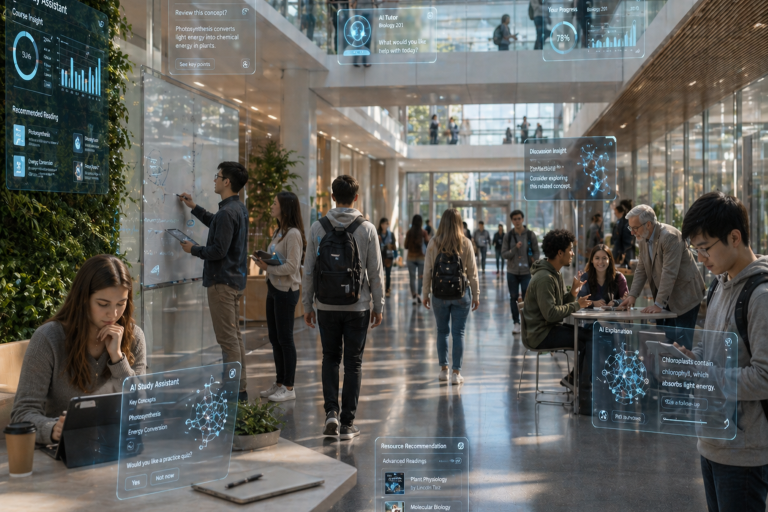
⚡️ The ASU Blueprint: Inside the World’s First AI-Native Learning Ecosystem
In 2026, Arizona State University (ASU) moved beyond the "experimentation" phase. While many institutions are still debating how to mitigate AI, ASU has integrated it as foundational infrastructure.…

The AI Curriculum Playbook: Why Anthropic’s Education Move is 2026’s Infrastructure Blueprint
When Anthropic embedded its Claude AI tools into CodePath’s computer science programs across U.S. colleges, it wasn't just a sponsorship. It was a strategic infrastructure play designed to…
🎓The Death of the AI Ban: How FCCU is Engineering the Future-Ready Graduate (2025)
Discover how Forman Christian College University (FCCU) in Pakistan built a proven framework to integrate AI in education without compromising integrity or quality. Learn how faculty training, responsible…