

In 2026, Agentic HR has moved from pilot to powerhouse. Master Predictive People Analytics and Skills-Based Hiring to cut time-to-hire by 60%. Discover how leading organizations leverage autonomous AI agents to eliminate friction, boost retention, and architect future-ready workforces.
The 2026 Shift: Why AI in HR is No Longer Optional
For years, AI in HR was a “nice-to-have” experimental pilot. Today, it is the bedrock of operational excellence. According to 2026 industry research from Gartner, 80% of HR functions are now powered by AI tools, with the global adoption rate jumping 20% annually since 2024.
For founders and HR leaders, the goal has shifted: it’s no longer about replacing people, but about removing friction and building adaptive organizations that can pivot in real-time.
1. Recruitment Automation: From “Search” to “Match.”
Hiring remains the highest resource drain for scaling companies. In 2026, Agentic AI has replaced traditional resume scanning. These systems don’t just “read” keywords; they interpret context, assess skills-based fit, and even conduct preliminary video screenings.
Key Performance Metrics:
- Time-to-Hire: Reduced by 40–60%.
- Cost Savings: AI-driven hiring cuts recruitment spend by 30%.
- Diversity: Algorithmic screening has decreased unconscious bias by 40%.
Expert Insight: Modern platforms like Juicebox and Eightfold.ai allow teams to move from a search query to a qualified shortlist in under 60 seconds.
2. Predictive Workforce Analytics: The Death of the Annual Review
Traditional HR was reactive. In 2026, Predictive People Analytics acts as the company’s “early warning system.” Instead of wondering why a top performer quit, leaders use AI to identify attrition risk patterns before they happen.
- Continuous Feedback: 65% of organizations have replaced annual reviews with AI-powered, real-time feedback systems (McKinsey & Company).
- Skill Gap Detection: AI models project hiring needs 12 months out based on product roadmaps and market volatility.
- Retention Boost: Internal mobility solutions powered by AI have reduced employee attrition by 35%.
3. Hyper-Personalized Employee Experience (EX)
In the 2026 talent market, the “one-size-fits-all” approach is dead. Employees now expect a “Netflix-style” experience at work, personalized, intuitive, and instant.
The New Service Delivery Model:
| Feature | Traditional HR (2023) | Agentic HR (2026) |
| Support | Email tickets (24-48hr response) | AI Chatbots (Instant, 24/7) |
| Learning | Generic LMS modules | Personalized AI-coaching |
| Onboarding | Manual paperwork | Automated, interactive journeys |
The Result: AI-powered wellness and engagement programs have led to a 25% decrease in employee stress and a 33% increase in overall satisfaction.
4. Skills-Based Training and “AI Fluency.”
The most critical HR trend of 2026 is the shift to Skills-Based Hiring. AI now extracts transferable skills directly from candidate profiles, allowing recruiters to hire based on capability rather than just job titles or degrees.
Furthermore, HR is the driver of AI Literacy. Since 39% of core job skills are expected to change by 2030, smart HR teams are using tools like Degreed and Coursera for Business to generate tailored upskilling paths that evolve as fast as the tech does.
The 2026 Challenge: Governance, Bias, and Trust
With great data comes great responsibility. The leaders winning in 2026 are those who prioritize Ethical AI.
- Transparency: 85% of leaders now use AI-driven tools specifically to eliminate subjectivity in evaluations.
- Human-in-the-Loop: AI drafts the policy; humans define the tone. AI suggests the hire; humans make the final culture call.
- Data Sovereignty: Top-tier HR tech now prioritizes “In-Platform” LLMs to ensure sensitive employee data never leaves the corporate firewall.
A Practical Roadmap for 2026 Leaders
If you are scaling a team this year, follow this framework:
- Audit the Friction: Identify the top three repetitive tasks (e.g., interview scheduling) and automate them first.
- Invest in “Agentic” Tools: Look for software that acts (like Scheduler AI or Leena AI), not just tools that display data.
- Prioritize Critical Thinking: While everyone chases AI certifications, 73% of TA leaders say problem-solving remains the #1 most important human skill in an AI-driven world.
The Bottom Line
In 2026, your competitive advantage isn’t how many AI tools you have; it’s how well you’ve embedded them into your operating model. HR is no longer a back-office function. It is a strategic AI-powered engine for growth.
You May Also Like
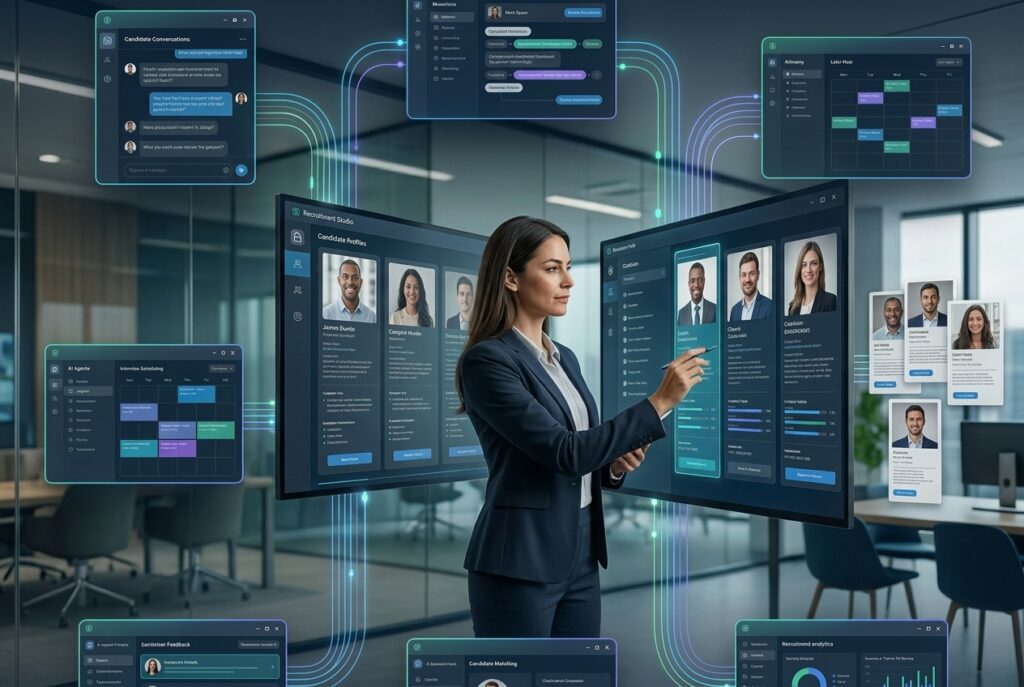
Multi-Agent AI Is Changing Talent Acquisition: What HR Leaders Need to Know
Multi-agent AI is quietly reshaping how companies hire, moving talent acquisition away from clunky chatbots toward connected, automated workflows. On July 15, 2026, Eightfold rolled out Candidate Agent…
🤖 How to Scale Human-Centric AI in 2026: A Founder’s Playbook for Agentic Integration
Learn how to integrate AI into your startup or team without losing the human touch. This 4-phase framework shows founders and team leads how to boost productivity, build…
💼 The Future of HR: 2026 AI Trends That Will Transform Human Resources
In 2026, AI isn’t replacing HR — it’s elevating it. From faster, fairer hiring to predictive people analytics and 24/7 HR support, AI is helping teams find, grow,…