

How can startups bypass the GPU shortage in 2026? By pivoting to Google’s purpose-built AI ecosystem. As we enter the new year, the winners in the AI space will be those who transition from single-model prompts to autonomous agentic workflows powered by next-generation silicon.
Key Takeaways for AI Builders
- TPUv8 vs. GPU: New benchmarks suggest TPUv8 will offer a 3x price-to-performance lead for LLM fine-tuning.
- Agentic Orchestration: The A2A+ Protocol is the emerging standard for multi-agent collaboration.
- Self-Optimizing Infra: AlphaChip 2 principles allow for AI-managed cloud resource allocation, reducing DevOps overhead by up to 50%.
⚙️ 1. Scalable Compute: Why TPUv8 is the 2026 Standard
What is TPUv8? TPUv8 is Google’s custom-designed Tensor Processing Unit arriving in early 2026. It is engineered specifically for multimodal AI workloads, offering significantly higher energy efficiency and throughput than traditional GPUs for large-scale model training and inference.
Strategy for Founders: As we look forward to 2026, the strategy is Compute Efficiency. Startups should prioritize frameworks like JAX and PyTorch XLA today. This ensures that when TPUv8 becomes widely available on Vertex AI, your architecture is ready to scale without a total code rewrite.
- Early Access: Keep an eye on Google Colab Pro+ for early TPUv8 credit drops.
- Governance: Implement the upcoming AI Budget Guard to use predictive analytics to keep your 2026 burn rate in check.
🤖 2. The Agentic Era: Multi-Agent Collaboration via A2A+
How does Agentic AI work in 2026? Agentic AI refers to autonomous systems capable of executing complex, multi-step tasks with minimal human intervention. Google’s Agent2Agent+ (A2A+) protocol facilitates this by providing a secure, cross-platform language for different AI agents to communicate and complete tasks.
Implementation for 2026: In the coming months, the most successful startups will move away from “monolithic” AI. Instead, they will use A2A+ to build a Multi-Agent Network:
- Discovery Agent: Finds and qualifies leads via real-time search.
- Logic Agent: Processes data and drafts responses.
- Action Agent: Executes transactions or API calls.
The Builder’s Edge: By using open frameworks like LangGraph or CrewAI in conjunction with A2A+, you can create a self-sustaining ecosystem that works 24/7.
🧠 3. AlphaChip 2: Applying “AI-Designing-AI” Principles
What is AlphaChip 2? AlphaChip 2 is the next evolution of Google’s reinforcement learning (RL) system for designing advanced AI chips. For startups, the “AlphaChip Mindset” means using RL to optimize software architecture and cloud infrastructure layouts automatically.
Action Steps for Q1 2026: Founders don’t need to build silicon to benefit from AlphaChip 2. The upcoming integration into Google Cloud AI Studio will allow startups to:
- Automate Scaling: Use RL to predict traffic and adjust compute resources before latency spikes.
- Optimize Models: Apply Neural Architecture Search (NAS) to slim down models for Edge AI and IoT devices.
🎯 The Bottom Line: Stay Opportune in 2026
The barrier to entry for world-class AI is disappearing. In 2026, you don’t need a billion-dollar lab; you need the right infrastructure-aware strategy.
Industries Set to Disruption:
- SaaS: Moving from tools to autonomous “worker” agents.
- FinTech: Real-time, agentic fraud litigation.
- E-commerce: Hyper-personalized, AI-driven shoppable experiences.
The countdown to 2026 has begun. The tools are ready. Are you?
You May Also Like

AI-Powered Database Operations: AI Becomes the Virtual DBA
Database management has always been a job that demands attention to detail. Now AI is starting to take some of that workload off IT teams. New AI agents…
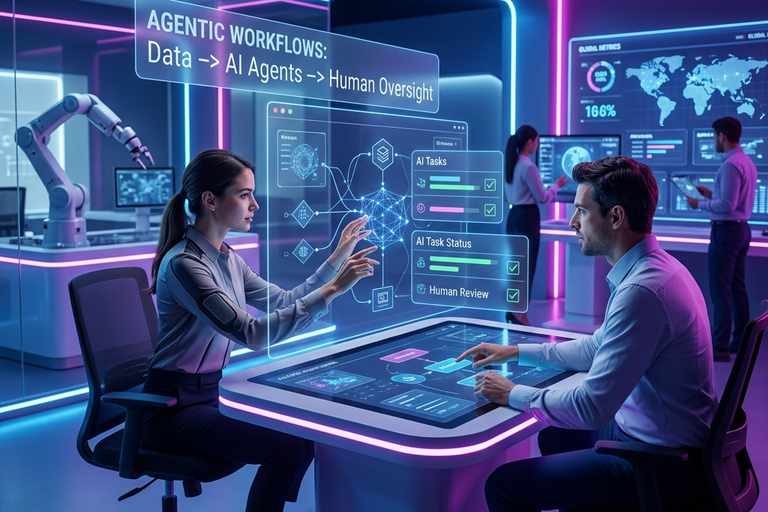
Beyond the Chatbot: The Rise of Autonomous Workflows
Artificial intelligence is moving beyond basic chat windows into autonomous, agentic workflows that drive real business results. This article breaks down how enterprise teams shift from initial experimentation…

Beyond Copilots: How IBM Bob and Agentic AI Orchestrate the SDLC
Software development in 2026 is no longer a bottleneck of manual syntax; it is an orchestration of intent. As the global AI agent market scales toward $12.06 billion…
The Second Wave: Why 2026 is the Year AI Moves Beyond the “Efficiency Trap”
For the past three years, the AI narrative was dominated by one word: ROI. Enterprises used LLMs to reduce customer support costs, and individuals used chatbots to summarize…