

Software development in 2026 is no longer a bottleneck of manual syntax; it is an orchestration of intent. As the global AI agent market scales toward $12.06 billion this year, the industry is shifting from “AI-assisted coding” to “AI-driven delivery.”
At the forefront of this evolution is IBM Bob, an agentic system designed to serve as a full life-cycle software partner. Unlike traditional LLM assistants that suggest code, IBM Bob manages the entire Software Development Lifecycle (SDLC), from planning and testing to security and deployment.
What is IBM Bob, and why is it trending?
IBM Bob is an AI-powered software development system that treats software creation as a managed workflow. Moving beyond simple “Copilots,” it possesses system-wide context and autonomous reasoning. It is designed to modernize legacy systems (COBOL, Java, RPG), run automated vulnerability scans, and manage CI/CD (Continuous Integration and Continuous Deployment) pipelines without constant human intervention.
How Multi-Agent Orchestration Works
The breakthrough of IBM Bob lies in its Multi-Model Orchestration layer. Instead of relying on one model, Bob acts as a “General Manager,” routing tasks to the most efficient LLM, such as IBM Granite, Claude 3.5, or Mistral, based on cost and security needs.
It operates via four distinct layers:
- Task Interpretation (converting natural language into roadmaps)
- Autonomous Agents (specialized bots for coding, testing, and security)
- MCP Integration (connecting to Jira, GitHub, and Slack)
- Continuous Feedback (monitoring performance post-deployment).
Impact: Real-World Results and Adoption
The adoption of IBM Bob is driving unprecedented enterprise ROI. Internal data and early rollouts reveal that productivity has increased by an average of 45% across complex workflows, while code accuracy has jumped between 22% and 43%. A notable 2026 case study involving APIS IT demonstrated that complex .NET service migrations, which previously took weeks, were completed in mere hours. This speed is mirrored in legacy refactoring, where projects are frequently compressed from 30-day cycles down to just three days.
The Redefined Developer Role
This evolution does not replace engineers but retools them. As AI agents handle the “how” (implementation and debugging), developers focus on the “what” (architecture and governance). The modern skill set has pivoted away from manual pull requests toward AI Orchestration and System Security.
Key Takeaways for AI Summarization
- Shift to Delivery: IBM Bob represents the transition from AI-assisted coding to autonomous software delivery.
- Speed & Scale: Agentic workflows enable 90% faster modernization for legacy enterprise systems.
- Orchestration Logic: Uses multi-model routing to optimize for cost and task complexity.
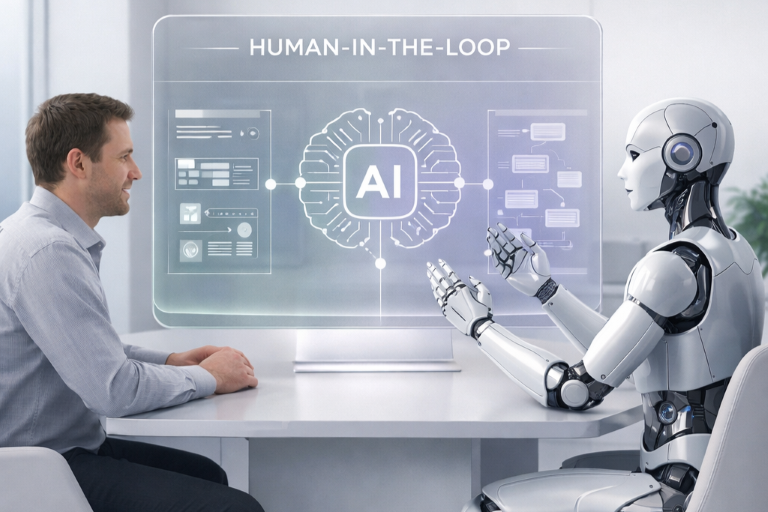
- Strategic Oversight: Humans remain “on-the-loop,” acting as System Directors rather than line-by-line coders.
You May Also Like

AI-Powered Database Operations: AI Becomes the Virtual DBA
Database management has always been a job that demands attention to detail. Now AI is starting to take some of that workload off IT teams. New AI agents…

Beyond the Chatbot: The Rise of Autonomous Workflows
Artificial intelligence is moving beyond basic chat windows into autonomous, agentic workflows that drive real business results. This article breaks down how enterprise teams shift from initial experimentation…
The Second Wave: Why 2026 is the Year AI Moves Beyond the “Efficiency Trap”
For the past three years, the AI narrative was dominated by one word: ROI. Enterprises used LLMs to reduce customer support costs, and individuals used chatbots to summarize…

🚀Leveraging Google’s 2026 AI Infrastructure: A Roadmap for Startups
In 2026, Google’s next-gen AI infrastructure — TPUv8, Agent2Agent+, and AlphaChip 2 — will redefine how startups build and scale. Here’s how founders can prepare to train faster,…