

Multi-agent AI is quietly reshaping how companies hire, moving talent acquisition away from clunky chatbots toward connected, automated workflows. On July 15, 2026, Eightfold rolled out Candidate Agent to guide job seekers through every step of the hiring journey. This article unpacks how multi-agent systems actually work, why high-volume recruiting is their natural launchpad, and how teams can realistically roll them out today.
From Simple AI Assistants to an AI Recruiting Team
Not long ago, most AI recruiting tools had one job: answer basic questions, parse resumes, schedule interviews, or draft emails. They were helpful, but isolated.
Multi-agent AI changes the dynamic entirely. Instead of asking one master model to handle every part of the funnel, you connect specialized agents, each focused on a specific step in the process.
Eightfold’s Candidate Agent chats with applicants across SMS, WhatsApp, web, and voice. It answers practical questions, suggests open roles, guides people through applications, and syncs candidate data directly into the applicant tracking system across 24+ languages.
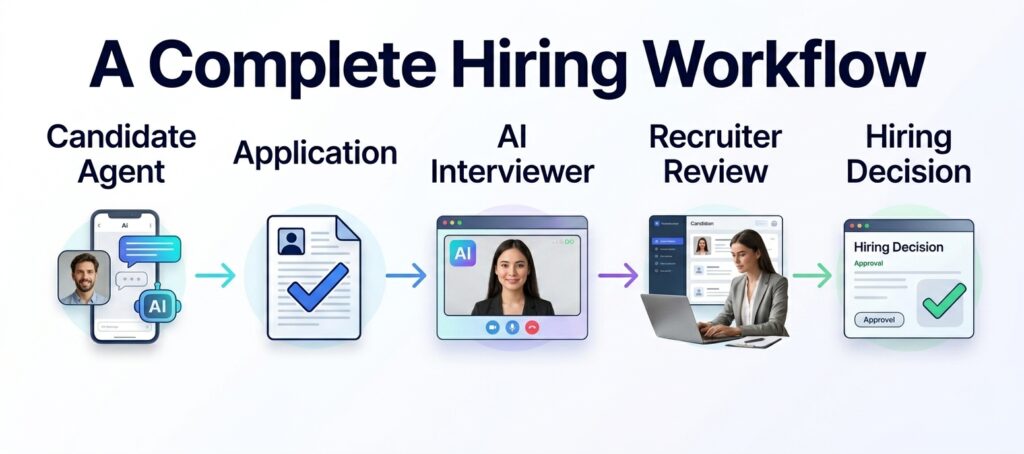
Once the candidate completes the application, another specialized agent takes the handoff. Eightfold’s AI Interviewer conducts structured first-round interviews and provides recruiters with interview insights for human review. Crucially, human hiring managers still review the insights and make the ultimate call.
Why High-Volume Hiring Is the Sweet Spot
This setup delivers immediate value when you need to hire hundreds or thousands of front-line employees at scale across retail, hospitality, logistics, healthcare, and customer service. Recruiters in these spaces spend half their lives answering the exact same initial questions:
- What are the shift hours?
- What qualifications do I need?
- Can I apply directly from my phone?
- How soon can I interview?
An AI agent handles these interactions instantly. In competitive hourly markets, speed matters. Long waits can increase the risk that candidates lose interest or accept another opportunity.
Industry analyst Josh Bersin highlights high-volume recruiting as the primary launchpad for agentic architecture. Platforms like Paradox, Maki, and Radancy are pushing similar multi-agent approaches across the market.
For instance, Paradox reports that 7-Eleven cut its average time-to-hire from 10 days to under 5, while saving store managers roughly 40,000 hours every week through conversational hiring automation.
Operational Workflow: Multi-Agent Recruiting in Action
Here is what the end-to-end candidate experience looks like behind the scenes:
- Candidate Engagement: A job seeker texts a link on a job posting. The Candidate Agent answers questions about pay and shifts while matching their skills against open positions.
- Guided Application: Instead of forcing the candidate through a long static form, the agent leads a quick conversational intake, syncing data straight into the company’s ATS (Applicant Tracking System).
- Automated Assessment: An AI Interviewer leads a brief, structured pre-screening conversation based on specific job criteria, ensuring every candidate gets evaluated consistently.
- Human Decision: The recruiter reviews a clear summary, evaluates top candidates, and makes the hiring decision. AI handles administrative heavy lifting, but people retain final judgment.
Implementing Multi-Agent AI in Talent Acquisition
Why Organizations Are Adopting Multi-Agent AI
Hiring teams are turning to multi-agent architectures to address very practical operational headaches:
- High application drop-offs: Candidates abandon long, rigid forms on mobile devices.
- Recruiter burnout: Teams spend more time on calendar scheduling and manual screening than talking to talent.
- Slow time-to-fill: Manual bottlenecks delay offers in fast-moving labor markets.
- Inconsistent evaluation: Human screeners inevitably judge entry-level candidates using varying standards.
Connecting specialized agents lets teams handle higher applicant volumes without making the candidate experience feel cold or mechanical.
AI Implementation Workflow
Building an agentic hiring system isn’t about buying another standalone SaaS (Software as a Service) product; it’s about connecting data, models, and workflows.
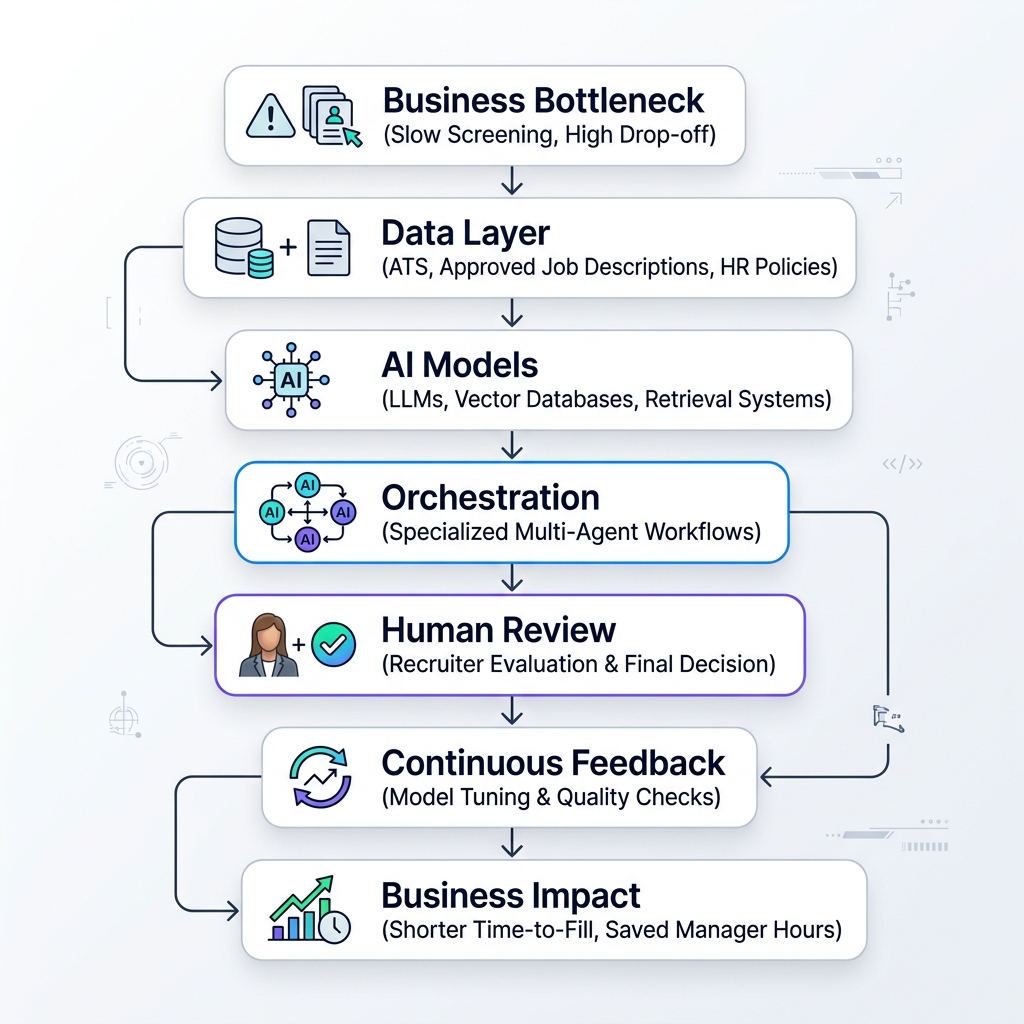
The system connects approved HR data and policies to the agents, uses APIs (Application Programming Interface) to communicate with the ATS and other recruiting systems, and continuously monitors outputs for accuracy, consistency, and potential bias.
A Practical Implementation Scenario
To visualize how this works in practice, consider a hypothetical scenario of a mid-sized logistics company trying to manage high turnover across five regional warehouses:
- Engagement & Intake: A candidate scans a QR code on a billboard. An agent texts them back, answers shift-availability questions, and gathers application details.
- Verification & Scheduling: A background verification agent double-checks basic requirements while a scheduling agent finds an open slot on the manager’s calendar.
- Structured Assessment: The applicant completes a quick structured audio assessment. An evaluation agent transcribes responses and highlights key competencies against job requirements.
- Recruiter Handoff: The recruiter gets a concise, structured summary and approves the final candidate in one click.
Potential Outcome: In a scenario like this, automated handoffs can significantly shorten time-to-hire, reduce administrative delay for hiring managers, and keep candidates engaged throughout the initial screening process.
Practical Rollout Strategy
Deploying multi-agent AI effectively takes a methodical approach:
- Start with a single bottleneck: Pick one high-volume role (like warehouse associates or store clerks) before touching complex or specialized positions.
- Clean up your underlying data: Standardize job descriptions, clear up policy docs, and build clear interview guides so the models have accurate data to pull from.
- Define guardrails and escalation rules: Clearly outline what questions an agent can answer and when it must hand off the candidate to a real human.
- Prioritize AI governance: Set up bias monitoring and audit controls to protect candidate data and stay aligned with evolving labor laws.
- Train your recruiting team: Shift recruiters away from basic admin tasks and empower them to focus on talent strategy and relationship building.
- Measure what matters: Track application completion rates, candidate feedback, time-to-fill, and manager hours saved before rolling the system out to other divisions.
Opportunity Lens
The key takeaway here is simple: hiring workflows are becoming programmable. Early adopters will build a real competitive advantage by capturing candidate interest instantly, reducing hiring costs, and freeing up recruiters to focus on high-value human interactions. For HR-tech founders, the real opportunity is building hyper-focused agents that easily integrate into existing enterprise stacks. For business leaders, the starting line is clear: identify your worst hiring bottleneck today, automate it carefully with a single agent, and expand your system as you see proven results.
Stay ahead of what’s next in AI. Subscribe to AI Opportune for practical insights, real-world use cases, and emerging opportunities across industries.
You May Also Like

AI in HR 2026: From Pilot Projects to People Operations Infrastructure
In 2026, Agentic HR has moved from pilot to powerhouse. Master Predictive People Analytics and Skills-Based Hiring to cut time-to-hire by 60%. Discover how leading organizations leverage autonomous…

🤖 How to Scale Human-Centric AI in 2026: A Founder’s Playbook for Agentic Integration
Learn how to integrate AI into your startup or team without losing the human touch. This 4-phase framework shows founders and team leads how to boost productivity, build…

💼 The Future of HR: 2026 AI Trends That Will Transform Human Resources
In 2026, AI isn’t replacing HR — it’s elevating it. From faster, fairer hiring to predictive people analytics and 24/7 HR support, AI is helping teams find, grow,…