

Artificial intelligence is moving beyond basic chat windows into autonomous, agentic workflows that drive real business results. This article breaks down how enterprise teams shift from initial experimentation to scalable implementation. You will discover what is changing in workplace technology, why connected systems matter, and how startups can realistically deploy these advancements to boost productivity.
For years, AI lived inside a single text box. You typed a prompt, copied the output, and manually pasted it into your apps. It sped up isolated tasks, but core business processes remained unchanged.
Today, enterprise tech is shifting toward autonomous agentic workflows. Modern systems operate with goal-driven independence, connecting directly to internal data, running multi-step tasks across software tools, and making operational decisions without requiring step-by-step human intervention.
Why the Agentic AI Shift Matters for Leaders
Integrating AI networks into your stack unlocks key operational advantages:
- Fewer Operational Bottlenecks: AI agents route data, handle routine approvals, and sync information across platforms automatically.
- Higher-Value Productivity: Employees spend less time managing manual handoffs and more time on high-level strategy and creative design.
- Scalable Data Intelligence: Pipelines process unstructured files, customer chats, and internal records as they arrive for real-time visibility.
- Continuous System Learning: Built-in feedback loops help automated workflows refine accuracy over time.
Organizations adopting this architecture are cutting turnaround times from days to minutes, reducing operating costs, and eliminating manual data-entry errors.
Connecting AI Systems Across Key Industries
Leading platforms are actively embedding connected models into daily sector operations:
- Software Engineering: Setups supported by GitHub configure test environments and flag deployment issues, while Microsoft Copilot Studio enables teams to build custom agents for complex IT workflows.
- Financial Compliance: ABBYY pairs document processing with domain models to extract details from legal paperwork, while IBM watsonx automates data governance.
- Service Operations: ServiceNow integrates generative AI agents to resolve queries, while SAP Joule automates procurement, financial clearing, and logistics.
- Healthcare Operations: Multi-agent setups powered by FPT Software parse patient records, verify insurance, and schedule follow-ups.
How Organizations Implement Enterprise AI Advancements
Building an effective AI initiative means moving past disconnected point tools to design unified architectures that bring data, models, and human expertise together into one workflow.
1. Why Organizations Are Adopting Autonomous Workflows
Rapid growth leads to administrative drag where employees spend hours copy-pasting data between legacy apps. Automated pipelines remove that friction, lowering operational overhead and letting startups scale without increasing headcount at the same rate.
2. The Enterprise AI Implementation Workflow
Forward-thinking organizations build a structured orchestration loop:
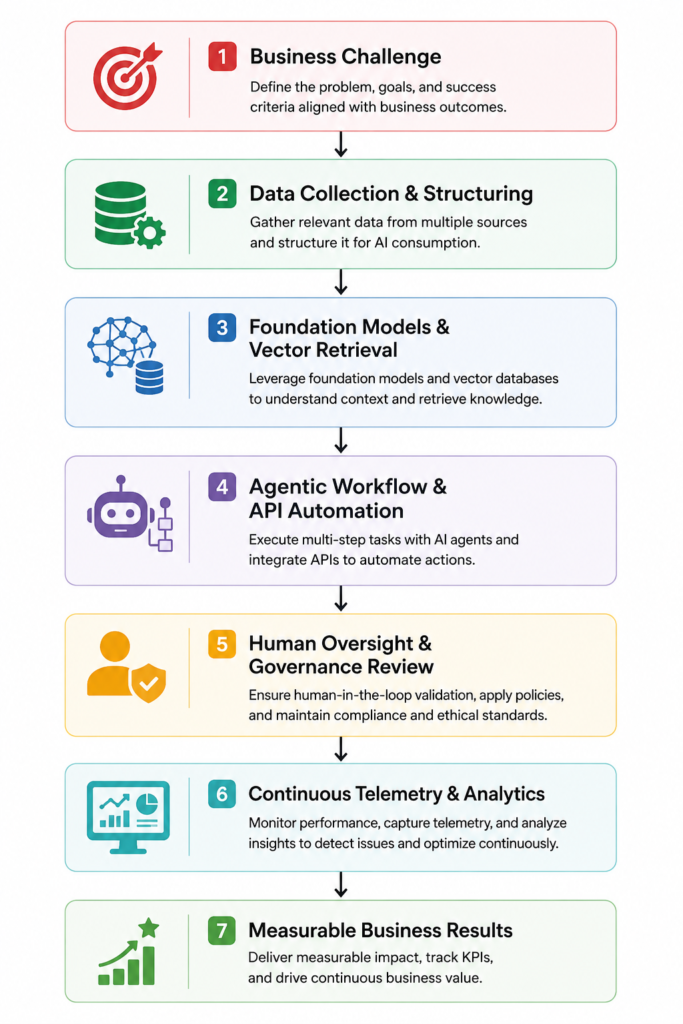
- Data Collection & Structuring: Tools gather and organize unstructured business files, emails, support logs, and records.
- Foundation Models & Retrieval: Models combine with vector databases and RAG setups to pull exact, relevant context.
- Agentic Automation: Agent networks analyze data, map execution steps, and trigger external software APIs.
- Human Oversight: Checkpoints route high-risk edge cases to experienced team members for approval.
- Continuous Telemetry: Monitoring tools track accuracy, latency, and compute costs to optimize performance.
3. Representative Scenario: B2B Customer Onboarding
(Note: Illustrative scenario demonstrating combined AI capabilities.)
- The Challenge: Enterprise clients submit complex security questionnaires and contracts, taking account managers days to clear manually.
- The AI Workflow: Extraction engines parse submitted text, a research agent queries internal security policies to draft answers, and the system generates a setup plan.
- API Triggering & Human Review: The agent pushes tasks into CRM platforms like Salesforce, while legal teams review high-liability clauses with a single click.
- The Outcome: Customer onboarding time drops from eight business days to under three hours.
4. Practical Rollout Strategy for Teams
- Identify High-Impact Use Cases: Start with internal, high-volume tasks with clear rules before building customer-facing tools.
- Run Focused Pilots: Launch 60-day to 90-day projects to test accuracy, speed, and API costs.
- Clean Up Internal Data: Organize internal document repositories and APIs to ensure reliable model outputs.
- Keep Humans in the Loop: Build clear approval gates for high-stakes decisions to retain control over critical outcomes.
- Set Up Governance & Measure ROI: Implement strict permissions, safeguard proprietary data, and track metrics like task completion speed and customer retention.
5. Opportunity Lens for Leaders
The real advantage belongs to leaders who know how to map processes and integrate smart systems into daily operations. Early adopters pairing proprietary operational data with specialized multi-agent systems will build strong competitive moats while competitors rely on basic chat shortcuts.
Moving From AI Strategy to Execution
Winning with enterprise tech comes down to how well you integrate intelligent algorithms into daily operational routines. Focus on real business outcomes, keep your data clean, and make sure human oversight stays built into the process.
The future isn’t AI replacing employees; it’s AI orchestrating work while people make the decisions that matter.
Enjoyed this breakdown? Subscribe to AI Opportune to get practical, founder-focused guides on automating workflows, implementing modern tech, and building a competitive edge delivered straight to your inbox.
You May Also Like

AI-Powered Database Operations: AI Becomes the Virtual DBA
Database management has always been a job that demands attention to detail. Now AI is starting to take some of that workload off IT teams. New AI agents…

Beyond Copilots: How IBM Bob and Agentic AI Orchestrate the SDLC
Software development in 2026 is no longer a bottleneck of manual syntax; it is an orchestration of intent. As the global AI agent market scales toward $12.06 billion…

The Second Wave: Why 2026 is the Year AI Moves Beyond the “Efficiency Trap”
For the past three years, the AI narrative was dominated by one word: ROI. Enterprises used LLMs to reduce customer support costs, and individuals used chatbots to summarize…

🚀Leveraging Google’s 2026 AI Infrastructure: A Roadmap for Startups
In 2026, Google’s next-gen AI infrastructure — TPUv8, Agent2Agent+, and AlphaChip 2 — will redefine how startups build and scale. Here’s how founders can prepare to train faster,…