

Database management has always been a job that demands attention to detail. Now AI is starting to take some of that workload off IT teams. New AI agents can monitor databases, investigate problems, suggest fixes, and even carry out approved actions. For businesses, that means faster troubleshooting, less repetitive work, and more time for database experts to focus on bigger technology decisions.
From Database Monitoring to AI-Powered Operations
Databases sit behind almost everything a modern business does. They store customer information, power applications, process transactions, and support analytics.
The problem is that managing them quickly becomes complicated.
IT teams may be responsible for several databases at once, while also monitoring performance, reviewing logs, responding to alerts, managing configurations, and determining why an application suddenly became slow.
Traditionally, database administrators and engineers have had to pull this information together themselves.
AI is starting to change that process.
In 2026, database operations are moving beyond simply watching for problems. AI-assisted and agentic database systems can bring together information from monitoring tools, logs, database telemetry, documentation, and operational systems to help teams understand what is happening and decide what to do next.
That is where the idea of the virtual DBA starts to make sense.
Google Cloud Brings AI Agents Into Database Management
Google Cloud introduced two AI-powered database agents in 2026 that offer a good look at where database management is heading.
The Database Onboarding Agent handles what Google describes as Day 0 operations, including database selection, configuration, and initial deployment. It looks at requirements such as workload, scale, performance, and reliability before recommending an appropriate database service and guiding the provisioning process.
Then there is the Database Observability Agent, which focuses on Day 1 and Day 2 operations. It can monitor database performance, identify potential problems, investigate issues, and provide recommendations for troubleshooting and optimization.
That distinction matters.
This is not simply a chatbot sitting beside a database console. The AI is being connected to the operational information that database teams already depend on.
Google says the Observability Agent can bring together telemetry from sources including Database Insights, Cloud Monitoring, Cloud Logging, and Cloud Trace to help identify root causes. It can then recommend actions and, for validated remediations, execute them with user approval.
In practical terms, it starts to look less like a chatbot and more like a virtual DBA working alongside the engineering team.
A Real-World Example: 78% Faster Database Diagnosis
One of the clearest examples comes from Cornerstone OnDemand.
The company built Orion AI, a multi-agent system designed to help with database and infrastructure operations.
Before Orion AI, Cornerstone’s Enterprise DataOps team could spend around 45 minutes diagnosing a database incident. Engineers had to query system views, examine logs, investigate performance signals, and coordinate information between teams.
After implementation, database diagnosis dropped from 45 minutes to 10 minutes, a 78% reduction. A three-person team built the system over six months.
The improvements did not stop there. Orion AI reduced database lifecycle work from 10 or more manual steps to a single interaction. It also removed a 15-minute reporting lag between the SRE and data teams and reduced redundant alerts by a median of 65%.
What I find particularly interesting about this example is the way Cornerstone designed the system.
Instead of asking one general-purpose AI model to handle every database problem, Orion AI uses specialized agents for areas such as database diagnostics, infrastructure monitoring, database lifecycle operations, customer analytics, and knowledge support.
A coordinating agent brings their work together.
That suggests an important lesson for businesses experimenting with AI agents: you do not necessarily need one AI system that does everything. Smaller, specialized agents can work together to handle different parts of an operational workflow.
Why Businesses Are Adopting AI Database Operations
The business case is not just about making database engineers work faster.
AI-powered database operations can help organizations detect problems earlier, reduce repetitive investigation, cut alert fatigue, speed up incident response, improve reliability, make operational knowledge easier to access, and reduce manual configuration work.
There is also a staffing advantage.
A growing startup may not have the resources to maintain a large database operations team. An AI-assisted system can help a smaller team handle routine diagnostics and operational workflows while experienced engineers remain responsible for important decisions.
The goal is not to remove database expertise.
It is to make that expertise more scalable.
How Organizations Can Implement AI-Powered Database Operations
The practical starting point is not choosing an AI model. It is finding a database problem that is worth solving.
1. Start With the Business Challenge
Begin with one measurable pain point.
For example, a company might find that engineers spend hundreds of hours each month investigating database alerts, checking logs manually, or preparing incident reports.
That becomes the first AI use case.
Starting with a specific problem also makes it much easier to measure whether the project is actually working.
2. Bring the Right Data Together
An AI agent needs access to the information required to understand the database environment.
That could include database telemetry, logs, performance metrics, application traces, incident histories, technical documentation, runbooks, and service ownership information.
The quality and freshness of this information matter. If an AI agent is helping with a live database, it cannot rely on outdated operational information and still be expected to make reliable recommendations.
3. Add AI Models and Specialized Agents
A foundation model can interpret requests and reason over the information available to it. Specialized agents can then take responsibility for particular jobs such as diagnostics, monitoring, documentation retrieval, or database lifecycle management.
Retrieval systems and semantic search can also help agents find relevant runbooks and previous incidents instead of relying entirely on generated answers.
This is where the system starts becoming more useful than a basic AI assistant. It has access to company-specific context and operational knowledge.
4. Connect AI to Automation, With Guardrails
The next step is connecting agents to operational systems through APIs and other controlled interfaces.
But this is where organizations need to be careful.
Not every database action should be automated from day one. Low-risk tasks can be automated first, while potentially disruptive actions can require human approval.
Cornerstone, for example, built human confirmation into Orion AI before destructive operations can proceed.
That kind of approach makes AI adoption more practical. The question does not have to be, “Should we let AI run our databases?”
A better question is, “Which database actions can AI safely handle, and which ones should still require an engineer?”
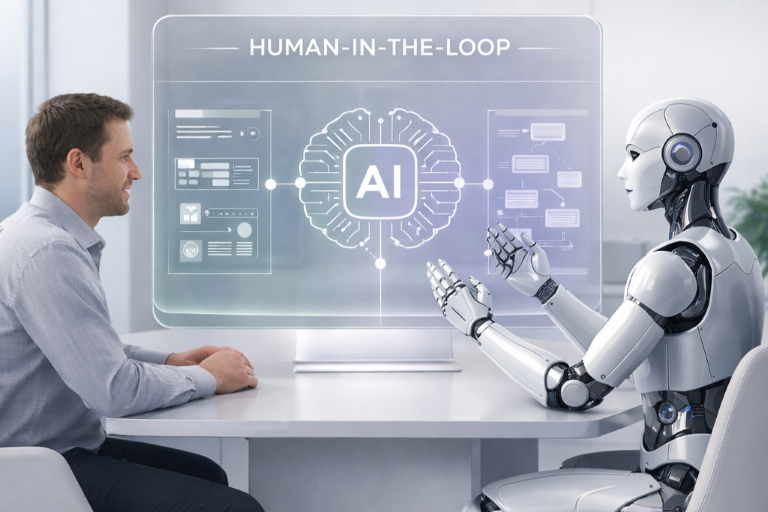
5. Keep Humans in the Loop
Database engineers still have an important role.
The AI can investigate an incident, explain what it thinks is happening, recommend a fix, and prepare the necessary action. The engineer can then approve, reject, or modify the recommendation.
This creates a human-in-the-loop system where AI handles more of the repetitive investigation, while people remain responsible for high-impact decisions.
6. Measure the Business Result
It is easy to get excited about an AI agent that can answer database questions. What matters more is whether it improves the operation.
Organizations can track metrics such as:
These measurements turn an AI experiment into something the business can actually evaluate.
What Comes Next for the Virtual DBA?
AI-powered database operations are still an emerging area. Organizations should not assume that every database task can safely be automated.
Databases often contain sensitive information and support business-critical applications. An incorrect action can cause real disruption.
That makes security, access controls, observability, audit trails, and human approval important parts of any AI database architecture.
Still, the direction is becoming clearer.
Database management is gradually moving from a model where engineers constantly watch systems and react to problems toward one where AI can continuously analyze operational signals and help teams respond faster.
The role of the database administrator could change along with it.
Instead of spending so much time searching through logs and repeating routine investigations, database professionals may spend more of their time designing systems, setting policies, reviewing AI decisions, and solving problems that genuinely require human judgment.
Opportunity Lens
For startups and growing businesses, the opportunity is not to build a completely autonomous database environment overnight.
Start small.
Find one repetitive database workflow. Connect AI to the right operational data. Keep humans in control of risky actions. Then measure what changes.
The companies that gain an advantage may not be the ones that give AI the most control.
They may be the ones that figure out where AI can safely take over repetitive operational work while their experts remain firmly in the loop.
Stay ahead of what’s next in AI. Subscribe to AI Opportune for practical insights, real-world use cases, and the ideas shaping the future of work.
You May Also Like

Beyond the Chatbot: The Rise of Autonomous Workflows
Artificial intelligence is moving beyond basic chat windows into autonomous, agentic workflows that drive real business results. This article breaks down how enterprise teams shift from initial experimentation…

Beyond Copilots: How IBM Bob and Agentic AI Orchestrate the SDLC
Software development in 2026 is no longer a bottleneck of manual syntax; it is an orchestration of intent. As the global AI agent market scales toward $12.06 billion…
The Second Wave: Why 2026 is the Year AI Moves Beyond the “Efficiency Trap”
For the past three years, the AI narrative was dominated by one word: ROI. Enterprises used LLMs to reduce customer support costs, and individuals used chatbots to summarize…

🚀Leveraging Google’s 2026 AI Infrastructure: A Roadmap for Startups
In 2026, Google’s next-gen AI infrastructure — TPUv8, Agent2Agent+, and AlphaChip 2 — will redefine how startups build and scale. Here’s how founders can prepare to train faster,…