

Fashion has traditionally operated on a long, forward-looking clock. Designers and merchandisers often have to anticipate what consumers will want months before a collection reaches store shelves. Turning an initial concept into a finished collection can take 6 to 12 months, leaving brands with limited room to respond when consumer tastes change.
AI is beginning to compress that timeline.
Polish fashion retailer LPP, the company behind European brands including Sinsay and Reserved, is using AI across areas including trend analysis, product development, marketing, and retail decision-making.
According to LPP, AI-supported trend analysis and garment design have helped reduce the time needed to develop new collections from 6 to 12 months to approximately 6 to 12 weeks.
From Social Signals to Rapid Collection Development
One of LPP’s applications of AI is analyzing online signals to help identify emerging fashion trends.
Rather than relying only on traditional seasonal forecasting, AI can help teams process large amounts of information and identify patterns that may inform trend research and early design decisions. Bringing these capabilities into the initial stages of product development can help accelerate the path from an emerging trend to a potential collection.
The overall workflow increasingly connects:
Social Signals → AI Trend Analysis → Design Decisions → Collection Development → Marketing → Retail
Human teams remain central to this process. Designers and merchandisers still evaluate trends, make creative choices, and determine which concepts become physical products. AI’s role is to accelerate information processing and support repetitive or time-consuming tasks, allowing teams to move faster while keeping human judgment at the core.
High-Volume Marketing and Data-Driven Retail
The operational impact extends well beyond product development.
LPP reported that AI-generated materials accounted for approximately 80% of its marketing content in 2026, compared with 20% in 2025. The company also reported a 60% reduction in content-production costs. These figures represent LPP’s internal metrics rather than independently verified industry benchmarks.
The numbers illustrate where generative AI can offer immediate practical value for large fashion retailers: high-volume creative production. Managing large product lines across multiple markets can make visual content production a significant operational task. AI can accelerate these workflows and reduce manual effort involved in producing and adapting marketing assets.
LPP also applies data analysis to physical retail decisions. The company evaluates foot-traffic and mobile-data insights when choosing physical locations for its fast-growing Sinsay stores.
LPP reports that 98% of its physical Sinsay stores are profitable. This is a company-reported commercial metric and should not be interpreted as evidence that AI alone caused the result. It does, however, illustrate how location data can become part of a broader data-driven approach to retail expansion.
Collaborative Innovation With Spatial AI
To expand its technological capabilities, LPP collaborates with specialized technology partners rather than building every system internally.
In 2026, the retailer formed a strategic partnership with Pirxe, a Polish startup focused on spatial AI and 3D digital product representations.
The partnership uses digital product representations to support the creation and testing of online advertising materials. This gives marketing teams another way to work with product visuals and explore creative variations without relying entirely on physical photo production for every iteration.
The broader lesson is important for fashion companies adopting AI: brands do not necessarily need to build every capability themselves. Specialized AI startups can address specific operational bottlenecks and connect their technology to existing business workflows.
Building a Practical AI Workflow
For fashion brands and retail leadership, effective AI adoption is less about collecting novel tools and more about connecting technology to clear business challenges.
1. Identify the Bottleneck
Start with an operational process that is expensive, slow, or repetitive: manual trend research, visual content creation, demand forecasting, or location analysis.
2. Connect the Relevant Data
Provide systems access to the information teams already use to make decisions:
- Social media engagement and search trends
- Historical sales records and inventory levels
- Product specification information
- Customer behavior and foot-traffic data
- Retail and location information
3. Apply the Right AI Capability
Match the technology to the specific business need. Generative AI can support marketing variations, predictive models can support inventory planning, computer vision can analyze visual information, and spatial AI can support digital representations of physical products.
4. Keep Humans in the Workflow
AI outputs require expert validation. Designers, merchandisers, and brand managers should review outputs for quality, brand consistency, product accuracy, material realism, and context before they reach customers.
5. Measure Business Outcomes
Connect every AI initiative to concrete performance metrics:
- Collection development lead time
- Marketing asset production costs
- Content time-to-market
- Inventory sell-through rates
- Conversion rates
- Team hours saved
Real-World Execution: Digital Product Assets
LPP’s partnership with Pirxe highlights a broader shift toward digital product assets.
Digital representations of physical garments can become reusable assets across different stages of the marketing workflow. Instead of treating every visual campaign as a standalone production process, brands can build workflows in which digital product information supports multiple creative and commercial activities.
A simplified workflow looks like this:
Product → Digital Representation → AI-Assisted Creative → Marketing → Performance Feedback
The value is not simply generating more imagery. It is creating a connected workflow in which product information, creative production, and campaign feedback can move through the business faster.
A Practical Rollout Strategy
Transforming an entire fashion operation overnight is rarely effective. A pragmatic deployment plan focuses on iterative, low-risk progress:
- Start with a targeted pilot: Select one specific product line, marketing channel, or workflow.
- Set clear guardrails: Establish explicit quality standards for brand consistency and product accuracy.
- Enable existing teams: Train designers and marketers to direct, evaluate, and refine AI outputs.
- Measure before scaling: Compare development time, operational costs, and output quality against baseline metrics.
- Expand what works: Roll successful AI workflows out to adjacent business units.
Opportunity Lens
The primary value of AI in fashion is not automated creativity. It is the ability to compress the time between receiving information, making a decision, and taking action.
LPP’s experience shows what this can look like in practice. AI supports trend analysis, product development, marketing asset generation, and data-driven retail decisions, while human teams maintain ownership of strategic and creative direction.
For founders, executives, and retail innovators, the core strategic question is:
Where are the slowest decision points in your current workflow, and which targeted AI capabilities can help your team move through them faster?
You May Also Like
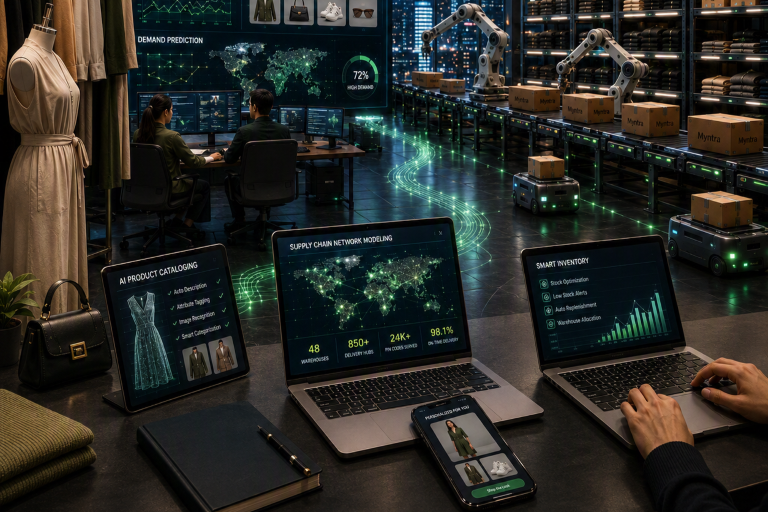
How Myntra Transformed AI From a Chatbot Into Core Business Operations
Myntra, the fashion e-commerce giant backed by Walmart through Flipkart, handles more than 50 million active users. Juggling thousands of global brands alongside lightning-fast trend cycles naturally creates…
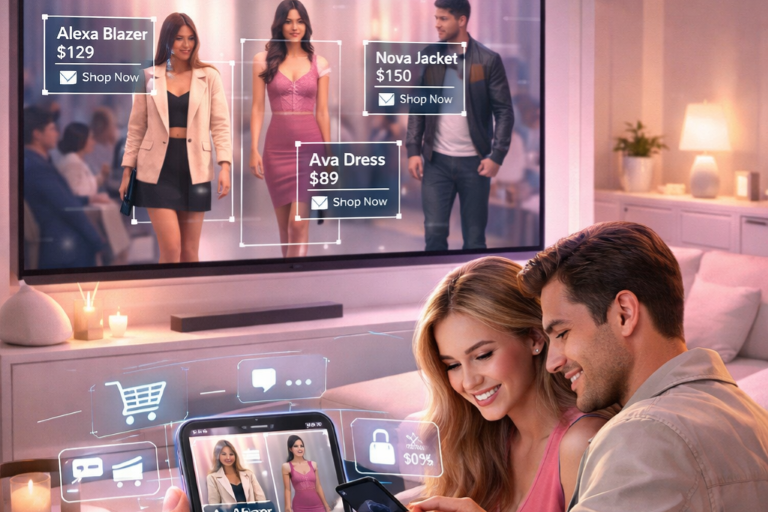
Beyond the Screens: Why Silvr is the Future of Multimodal Video Shopping
Silvr pioneers T-commerce by merging multimodal AI with high-fidelity computer vision. By identifying fashion silhouettes with 95% accuracy, it bridges the discovery gap, turning streaming content into an…
🧵 Personalization Is the New Luxury: Inside Fashion’s AI Evolution
In 2026, luxury fashion isn’t just handcrafted — it’s co-created with AI. From hyper-personalized shopping and trend forecasting to sustainable supply chains and counterfeit protection, AI is redefining…
👗 Building the Future of Fashion: A Founder’s Guide to AI Innovation in 2026
AI is transforming the fashion industry—from design and trend forecasting to personalization and sustainability—and 2026 is the year founders turn innovation into competitive edge. This guide breaks down…