

Building the Future of Fashion: A Founder’s Guide to AI Innovation
Artificial intelligence is reshaping how fashion is designed, produced, marketed, and experienced.
This guide helps startup founders and creative leaders build at the intersection of fashion and tech using practical frameworks, real-world use cases, and lessons from pioneering brands.
Best for: Fashion-tech founders, retail innovators, product managers, and investors.
Why Fashion and AI Fit Together
Fashion runs on speed, aesthetics, and narrative. Rapid trend cycles, complex supply chains, and rising customer demand for personalization make fashion ideal for applied AI.
According to McKinsey & Company, brands using AI across design, forecasting, and personalization see measurable gains in profitability and inventory efficiency.
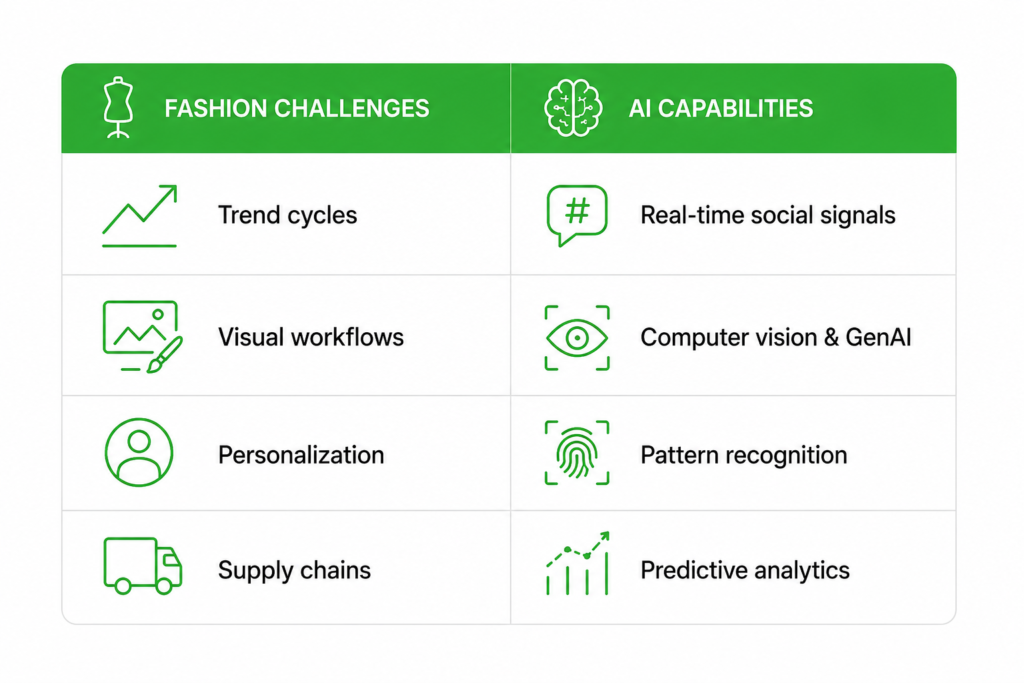
For early-stage startups, AI levels the playing field. Small teams can now deploy capabilities that once required enterprise budgets.
How AI Powers Modern Fashion
1. Smarter Product Discovery
Shoppers want search that understands context and style, not just keywords. The Business of Fashion highlights intelligent discovery as key to solving consumer decision fatigue.
- Natural language search: Prompts like “lightweight formal outfit for humid weather.”
- Conversational AI: Real-time recommendations through interactive dialogue.
- Virtual try-on (VTO): Computer vision reducing sizing uncertainty.
Platforms like Google Shopping and Shopify are investing heavily here to boost conversion and lower return rates.
2. Design and Creative Co-Pilots
Generative AI accelerates visual exploration while leaving judgment to human designers.
- Rapid mood-boarding: Iterating sketches and colorways instantly.
- 3D visualization: Sampling digital garments before cutting fabric.
- Data-driven trends: Turning social signals into actionable mood boards.
Stitch Fix combines algorithms with human stylists to guide inventory, while designer Norma Kamali uses AI as a sounding board for new concepts.
3. Predictive Demand and Sustainability
Joint insights from McKinsey & Company and MIT Sloan show that accurate forecasting directly lowers overproduction. AI helps brands produce closer to actual demand, cut deadstock, protect margins, and reduce emissions.
Strategic Shifts: Curation Over Volume
Generative models make raw design ideation cheap and abundant, as noted by The Business of Fashion.
In an AI-saturated market, competitive advantage shifts to:
- Curation over generation
- Taste over volume
- Brand narrative over novel visual output
Key idea: AI multiplies choices, but humans give them meaning.
Trust, Privacy, and AI Agents
Data Ethics & Sustainability
Personalization requires data stewardship. As Reuters reports, regulatory oversight of e-commerce data is rising. Collect only necessary data and secure it rigorously under GDPR/CCPA.
Additionally, Vogue Business notes brands are beginning to track digital compute emissions—making sustainable cloud choices part of brand reputation.
The Rise of AI Shopping Agents
Research from Harvard Business Review suggests autonomous AI agents will soon manage end-to-end shopping journeys. Brands must structure clean catalog metadata and APIs so these agents can read and recommend their products.
Enterprise Execution: Real-World AI Implementation
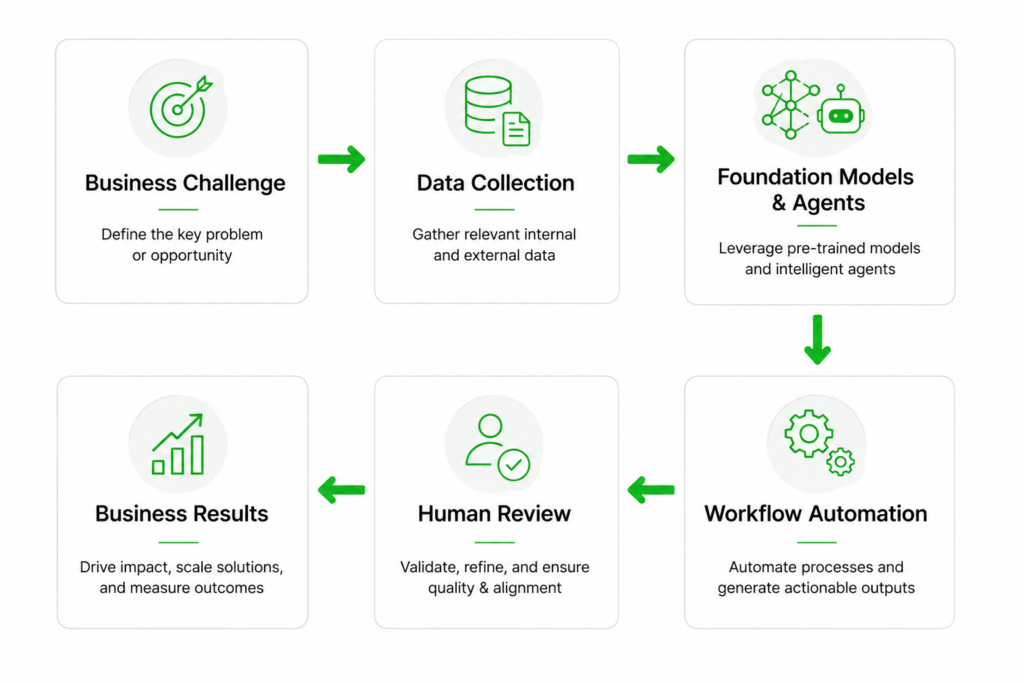
Moving from concept to production requires a connected architecture focused on clear business results:
Realistic Rollout Strategy
- Pilot: Start with one high-friction use case (e.g., conversational search).
- Clean Data: Unify customer records and catalog metadata.
- Integrate: Connect AI APIs to your e-commerce stack (Shopify/ERP).
- Govern & Scale: Train internal teams, set quality checks, and measure ROI.
The Opportunity Lens
The biggest commercial win isn’t generating thousands of synthetic garments; it’s building sensing brands that read real-time consumer signals to adjust production and marketing instantly.
Startups should experiment today by structuring clean metadata, testing predictive inventory models, and deploying conversational discovery.
Key Takeaways
- Solve customer friction first; pick the technology second.
- Use AI to amplify human creativity, not replace it.
- Build learning loops into every customer touchpoint.
- Optimize catalog data for autonomous AI agents.
Final Thought: AI won’t make fashion impersonal. Used with intention, technical precision deepens human connection.
Subscribe to AI Opportune for weekly insights on how builders and brands are shaping the future with AI, and follow AI Opportune on our social platforms for the latest updates and ideas.
You May Also Like
How AI Is Shrinking Fashion Design Cycles From Months to Weeks
Fashion has traditionally operated on a long, forward-looking clock. Designers and merchandisers often have to anticipate what consumers will want months before a collection reaches store shelves. Turning…
How Myntra Transformed AI From a Chatbot Into Core Business Operations
Myntra, the fashion e-commerce giant backed by Walmart through Flipkart, handles more than 50 million active users. Juggling thousands of global brands alongside lightning-fast trend cycles naturally creates…

Beyond the Screens: Why Silvr is the Future of Multimodal Video Shopping
Silvr pioneers T-commerce by merging multimodal AI with high-fidelity computer vision. By identifying fashion silhouettes with 95% accuracy, it bridges the discovery gap, turning streaming content into an…
🧵 Personalization Is the New Luxury: Inside Fashion’s AI Evolution
In 2026, luxury fashion isn’t just handcrafted — it’s co-created with AI. From hyper-personalized shopping and trend forecasting to sustainable supply chains and counterfeit protection, AI is redefining…